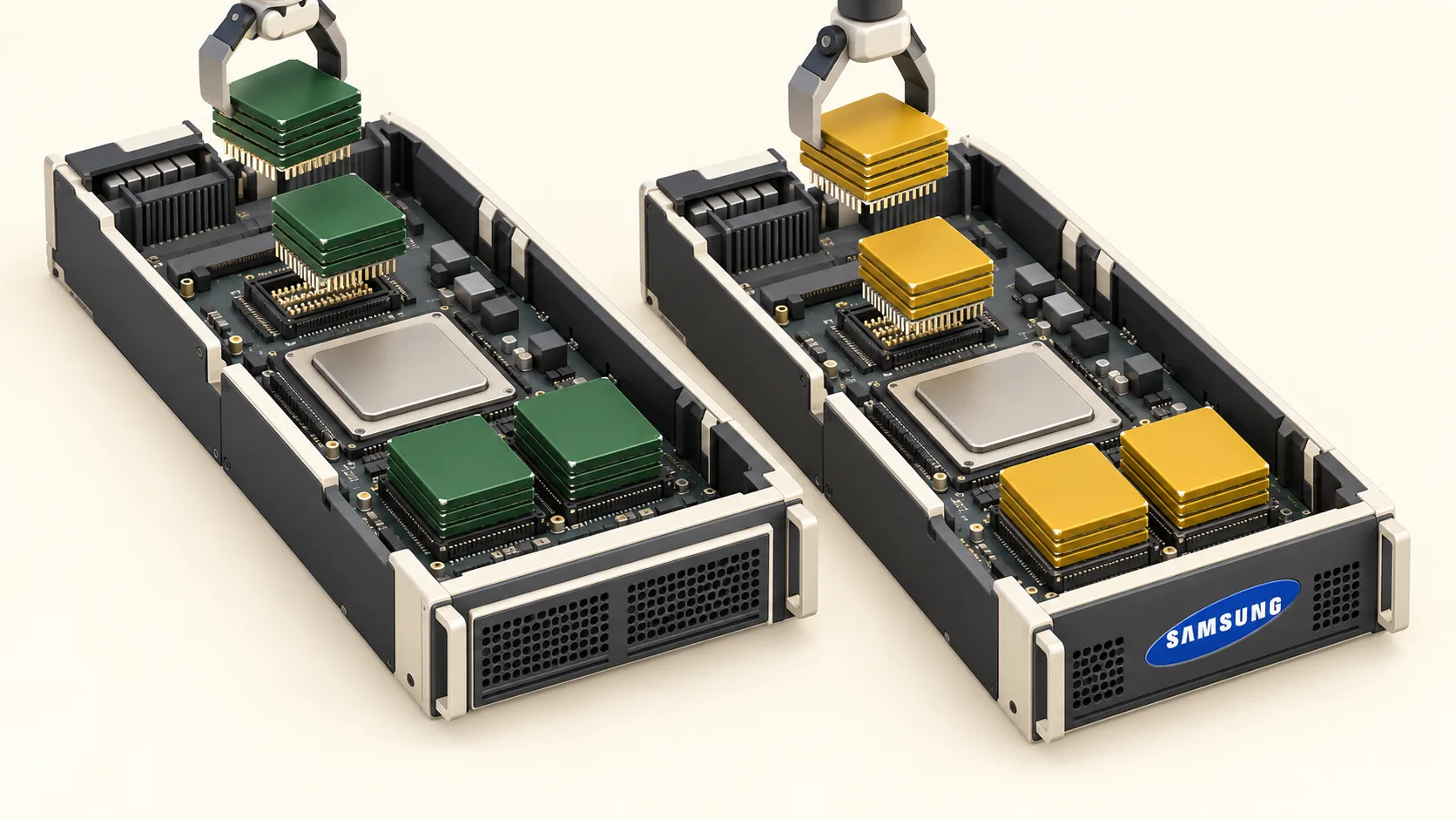

Two South Korean companies currently control 83 percent of the global memory chip market. Now they are racing each other to grab the top spot by tightening their ties to U.S. firms.
SK Hynix has held a long lead in the global high-bandwidth memory market. It relies on more advanced core technologies and an early foot in the door with Nvidia. These specialized memory chip interfaces allow artificial intelligence processors to access large amounts of data quickly. They serve as a crucial component of powerful systems that train and run AI models.
Over the past year, Samsung has more than doubled its market share. It stole away SK Hynix business while forging new pacts with Nvidia and OpenAI.
Samsung expands US and partner ties
For U.S. AI companies such as Nvidia and OpenAI, the rivalry matters because control over this critical component could affect how quickly and cheaply they can build the next generation of AI infrastructure. Christopher Miller is an associate professor of international history at the Fletcher School of Law and Diplomacy at Tufts University and author of Chip War. He notes that technology leadership still matters, but capacity is now just as important because the entire memory industry faces constrained production capacity.
All leading dynamic random access memory companies are trying to use deals and long-term agreements with customers to make their high-bandwidth memory products more customized. This shifts them from a traditional commodity business to a more specialized product offering.
SK Hynix is deepening ties with the U.S. AI industry through a $4 billion advanced packaging facility in Indiana, where it broke ground in August. Samsung has also steadily grown its American footprint. In March 2025, Samsung collaborated with Nvidia to advance artificial intelligence radio access network technology, which embeds AI directly into cellular base stations and mobile network equipment.

OpenAI deals drive memory competition
In October 2025, Samsung joined OpenAI's Stargate project alongside SK Hynix to expand AI infrastructure. Samsung and Nvidia also plan an AI factory. That effort forms part of a Korea-wide initiative to deploy 260,000 Nvidia graphics processing units to Samsung, SK Hynix, Hyundai, Naver, and the Korean government, with Samsung receiving around 50,000.
In June 2026, OpenAI made ChatGPT Enterprise and Codex available to all Samsung Electronics employees in Korea and device-experience employees worldwide. OpenAI called the deployment one of its largest to date. By September 2026, OpenAI announced it was working with Samsung on next-generation chips.
Ben Reynolds is a senior analyst at independent research organization Rhodium Group. He explains that Nvidia allocation decisions remain the predominant factor determining high-bandwidth memory market share. Samsung competitiveness with SK Hynix will depend above all on whether it can poach share from SK as a supplier for Nvidia Vera Rubin. Building relationships with alternative AI chip suppliers like AMD and Broadcom provides a secondary opportunity to build share.
 Read nextAI Agents Enter the Workforce as Digital Coworkers
China operations present growing risks
Both SK Hynix and Samsung remain deeply exposed to China, where they operate legacy plants and continue to test new chipmaking tools. The Washington-Beijing tussle complicates matters. Wooing the U.S. costs them business with China, and China is finding domestic replacements that will prove hard to beat later.
Until 2025, chipmakers could ship export-controlled tools to their China fabrication plants without applying for a license under the Validated End User Program. The Donald Trump administration eliminated that program in 2025 and replaced it with an annual licensing process. Nearly every major Chinese semiconductor toolmaker now sits on a U.S. trade restriction list.
In China, the companies face tough competition from fledgling domestic alternatives. Counterpoint analyst Hwang notes that the Chinese market is vital and accounts for roughly one-third of the global market. However, the inherent risk is the potential loss of global market leadership. While early entry brought subsidies and incentives, ongoing technology advances in China combined with a lack of a viable exit strategy mean strategies targeting China present increasingly complex risks relative to expected returns.