
A new Nvidia research paper introduces a system that automatically optimizes the control layer of coding agents, known as the harness. According to the researchers, token usage drops by almost half while performance stays roughly the same. Longer unsupervised AI agent sessions become increasingly expensive. Single predictions turn into long chains of reasoning, tool calls, and feedback loops that cause token usage to balloon.
A new study from Nvidia researchers addresses these rising costs at the harness level rather than the model level. The harness is the control layer sitting between the model and its environment, utilized by systems like Codex, Claude Code, or OpenClaw. This component controls how an agent views states, runs actions, and processes feedback.
Most efficiency methods previously focused on cutting the cost per token through faster attention kernels, serving infrastructure, model compression, or cheaper models. Optimizing the harness itself is difficult because tool usage, context management, verification, and abort logic are tightly coupled. Human developers usually sift through long execution traces and translate recurring failure patterns into code by hand.
 Read nextOkta-Led Alliance Urges AI Agent Kill Switch and OAuth Token Control
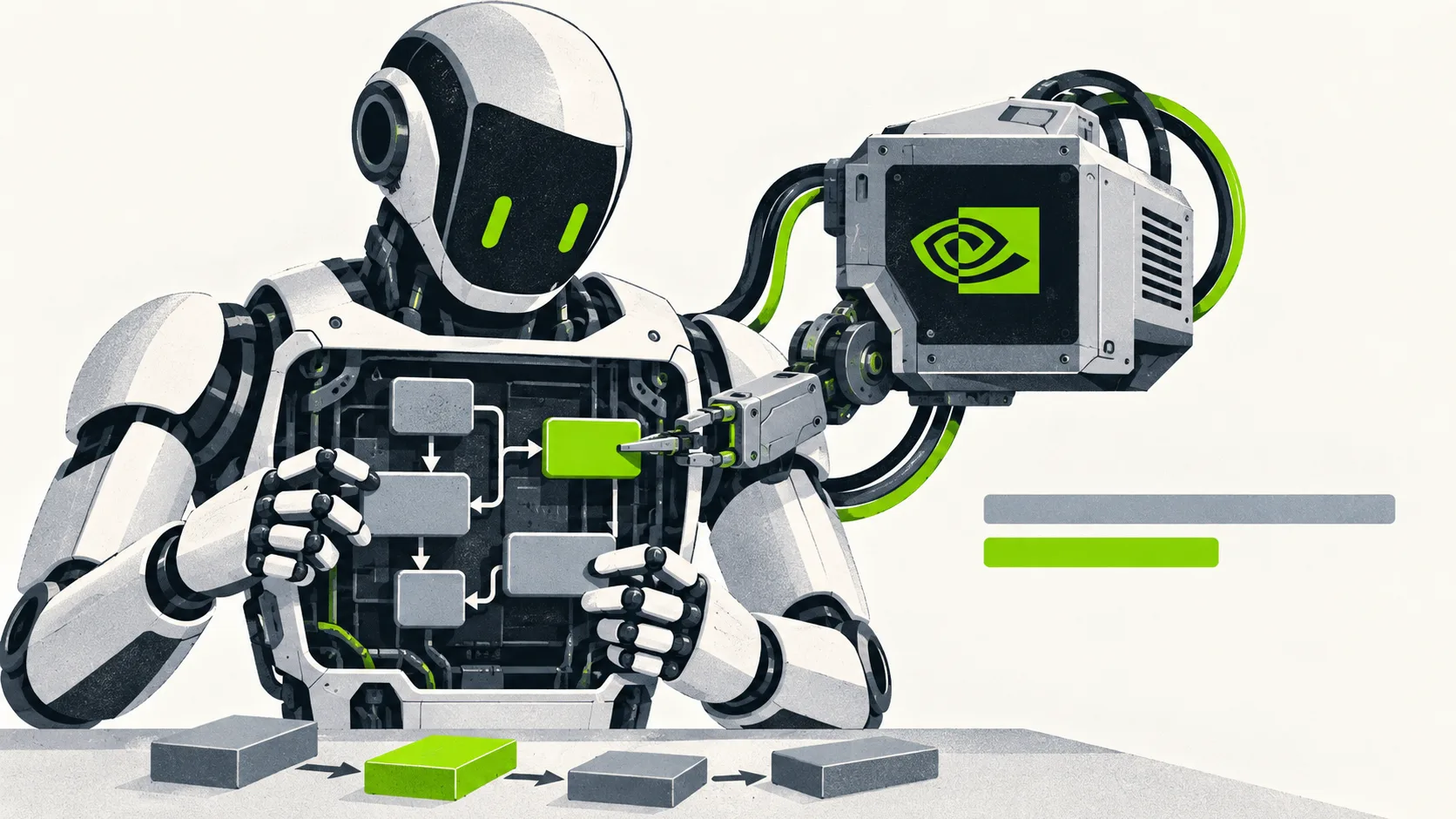
The new system, called SoL-Pi, automates that process. A research agent watches another agent traces, proposes changes, and tests them in prepared environments. Capability and efficiency checks determine which candidates survive. According to the authors, the approach draws on recursive self-improvement.
Across 535 executable environments, the system explored 152 directions, including 495 tasks derived from GitHub issue-pull-request pairs and 40 synthetic test cases. The process generated more than 3,000 runs and over 60,000 agent-environment interactions. The researchers note that this scale demonstrates the breadth of the search process.
To prevent the overfitting that plagued earlier automatically optimized harnesses, SoL-Pi strictly separates search feedback from evaluation. The researchers walled off EdgeBench from the search process entirely. They used 11 of its 51 public tasks for one-time validation, and reserved the remaining 40 for final evaluation without feeding those results back into the search.
The search produced four distinct mechanisms that eliminate wasted work. Action Fusion merges two consecutive steps into one to eliminate a language model call. Online Context Compact trims accumulated context after each planning step. ObservationPack archives long tool outputs and drops in a short summary on later steps. The Evidence-Preserving Reducer routes large logs to a cheaper model for summarization with an automatic verification step.
On EdgeBench, SoL-Pi performs about as well as the original Pi harness according to the researchers. The efficiency variant combining all four mechanisms uses 49 percent fewer tokens and reaches 93.7 percent of Pi score. Users prioritizing performance who pick only the strongest single mechanism beat Pi score by 5.3 percent while still saving tokens.
The authors estimate savings of $8.75 to $13.50 per hour compared to native Codex and Claude Code harnesses, and $4.36 to $5.71 per hour compared to Pi, based on current API prices. Total costs in one test run dropped from $1,339 to $894. However, these efficiency gains come with trade-offs because shorter context can reduce prompt cache reuse.
Results vary across other benchmarks. On 63 CPU tasks from Terminal-Bench 4, SoL-Pi solves 15 tasks while Codex and Pi each solve 18, though total costs came in about a quarter lower than Pi. On Lean 4 tasks from the 2026 Math Olympiad, the system cracked three of six problems at the lowest cost per solved problem. In a kernel optimization test, 20 SoL-Pi workers cut costs by 26.8 percent compared to a comparable Pi swarm.
Looking ahead, the authors suggest pretraining the harness across many tasks and using an already lean harness to make searching for its successor cheaper. They describe this recursive efficiency improvement as a vision rather than a current finding.