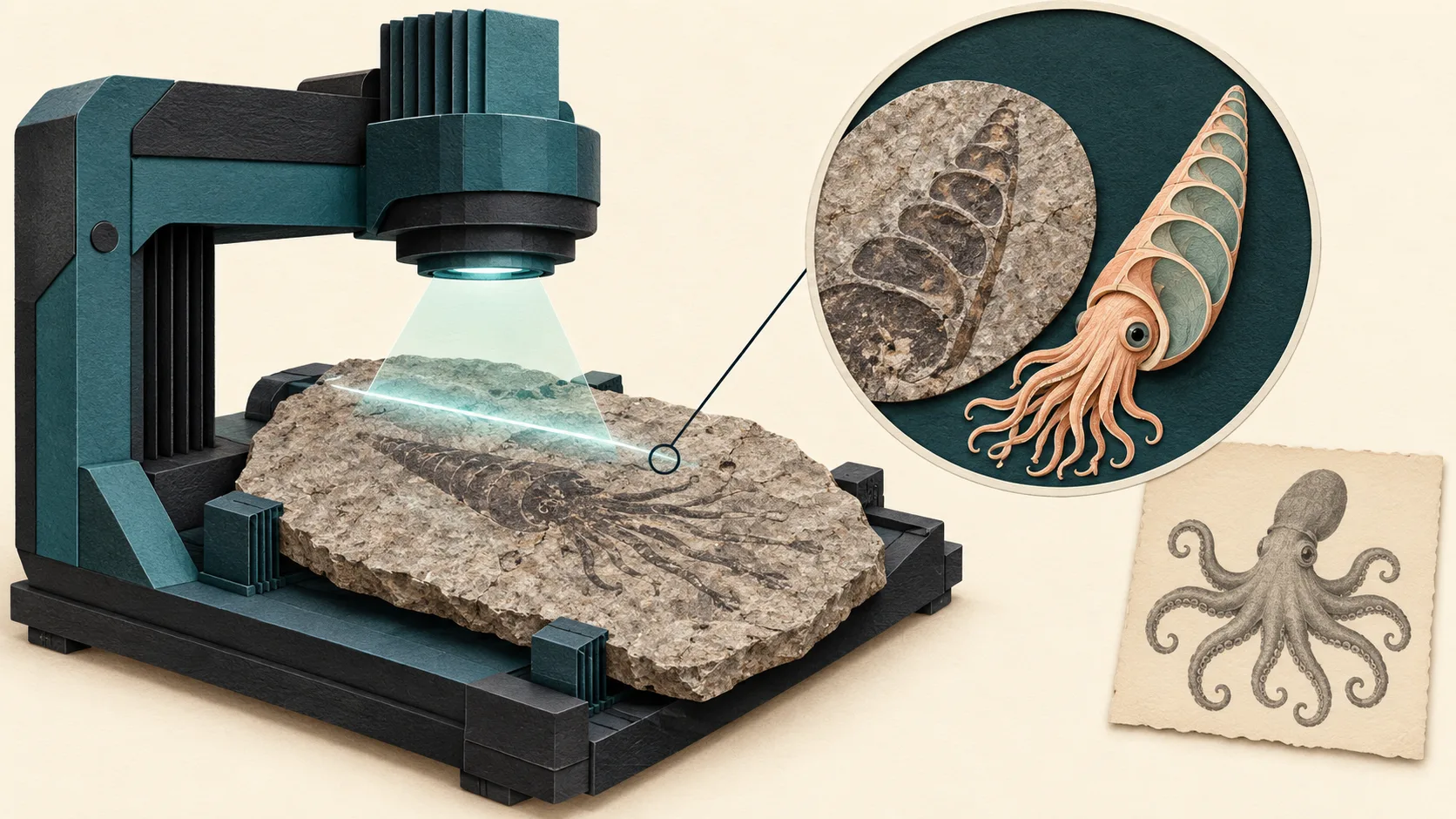

For over two decades, a fossil dubbed Pohlsepia mazonensis held the esteemed title of the oldest known octopus, dating back a staggering 300 million years. This unassuming specimen, unearthed in Illinois, challenged existing timelines of cephalopod evolution, suggesting octopuses emerged far earlier than previously thought. Now, cutting-edge analysis has revealed a case of mistaken identity: Pohlsepia isn't an octopus at all.
Paleontologist Thomas Clements and his team at the University of Leicester employed advanced imaging techniques to re-examine the fossil. Their findings, recently published, debunk the original classification, revealing that Pohlsepia is actually a poorly preserved nautiloid. The misidentification stemmed from the unique fossilization process at the Mazon Creek Lagerstätte.
The Mazon Creek Deception
Around 300 million years ago, the Mazon Creek area was a muddy marine environment. When organisms died and were buried in the iron-rich sediment, a mineral called siderite formed around their bodies, creating hard nodules. While this process preserved soft tissues, it flattened the organisms into two-dimensional stains on the rock. Early paleontologists, faced with these ambiguous shapes, interpreted Pohlsepia as having octopus-like features. Read nextMeta, MIT and University of Washington Researchers Introduce Context Language Models
A Cephalopod Rorschach Test
The original researchers believed they saw a sac-like head and mantle, symmetrical fins, and even eyespots. The absence of a shell further cemented the octopus hypothesis. However, key octopus characteristics were missing, such as suckers and cirri (the hair-like strands on finned octopuses). The team had initially dismissed some lighter stains as fluids leaking from the carcass, but a closer look revealed that this was no octopus.This paleontological plot twist underscores the challenges of interpreting ancient fossils, especially those preserved in unusual conditions. While Pohlsepia may be off the hook, the quest for the oldest true octopus continues, and our understanding of cephalopod evolution takes a new turn.