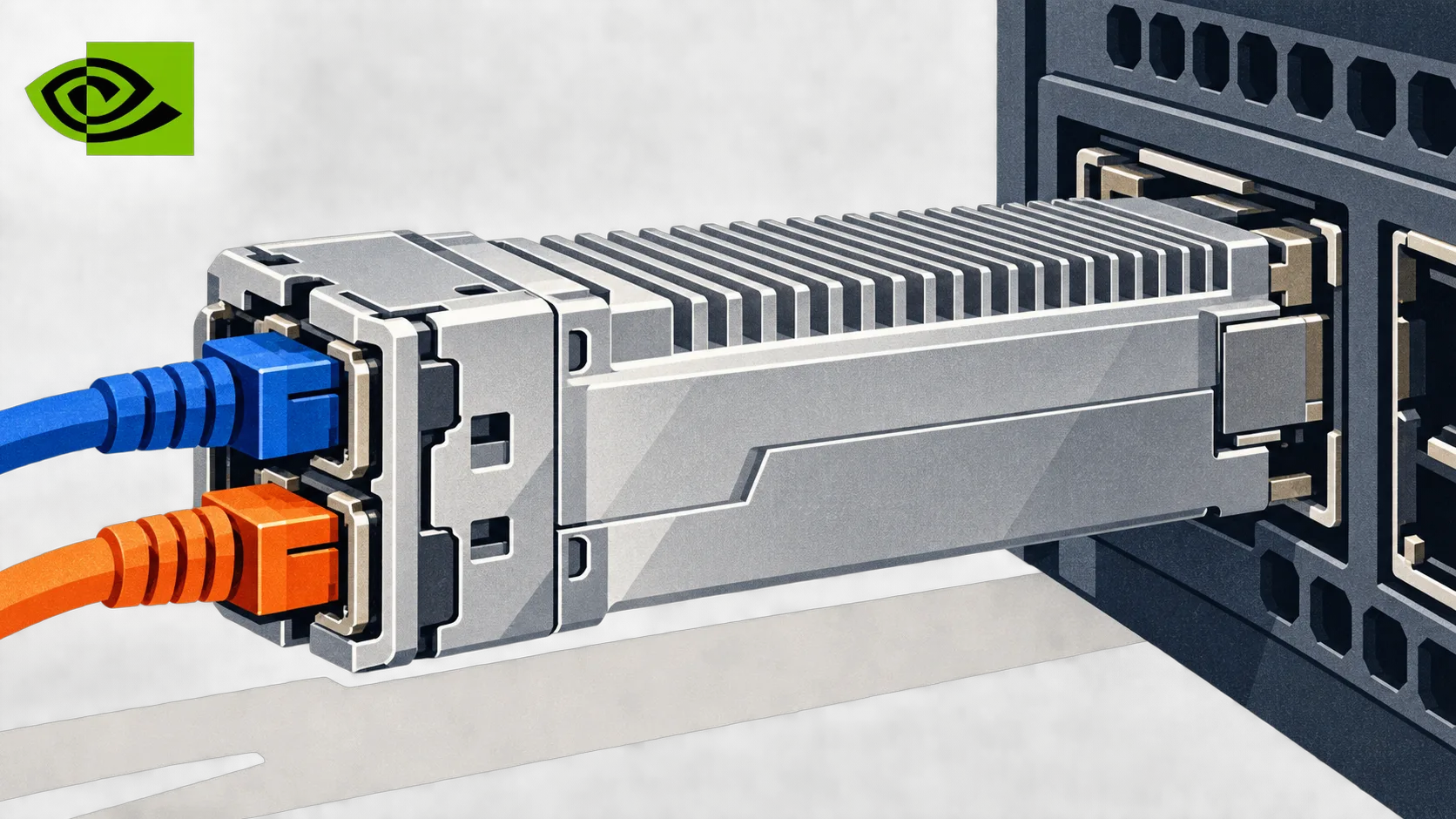

Nvidia and Cisco have announced plans for Ultra-Dense Small Form Factor Pluggable, or USFP, an optical module for AI data center networks. It is designed to carry 400 gigabits per second per lane, twice the rate of the 200-gigabit-per-second-per-lane modules the companies use as a comparison.
The first planned USFP transceivers will have 16 full-duplex lanes in a footprint the size of an octal small form factor module. They are intended for switches and SuperNICs. Nvidia says the design could provide 12.8 terabits per second of overall capacity and connect more 1.6-terabit-per-second endpoints without adding network tiers.
Compared with 200-gigabit-per-second-per-lane pluggable modules, Nvidia says USFP is designed to offer four times the bandwidth and front-panel bandwidth density, with approximately 1.3 times the power efficiency. Those figures describe the planned design, not a product the companies say is available now.
The connector supports more lanes
USFP uses a two-dimensional connector that engages its high-speed contacts after the module is inserted. Nvidia says this design reduces contact wear and improves signal integrity. The connector is intended to support 32 full-duplex lanes or more in future versions.

The companies also say USFP can dissipate up to 100 watts without a separate cooling circuit inside the transceiver. The aim is to fit more connections into switches while retaining the installation and replacement model used for pluggable optics.
The companies plan a shared specification
Nvidia and Cisco are working with TE Connectivity and Amphenol on USFP cages, connectors and modules. They have not announced when the first transceivers will be available. Their next stated step is to create an open USFP industry specification through an upcoming community-led multi-source project.