

Researchers from Meta, MIT, and the University of Washington introduced Context Language Models, a new approach that enables language models to manage and edit their own context. The method avoids relying on predefined mechanisms for summarization, compression, and information retrieval. The developers reported substantial gains in both performance and computational efficiency.
Conventional context management strategies prevent context from growing indefinitely through compaction, offloading, and retrieval. However, each technique has distinct limitations. Summarization can discard critical details or introduce inaccuracies. Compaction often uses a predefined set of rules, and external memory requires agents to decide what to bring back into the context.
Language models edit context files
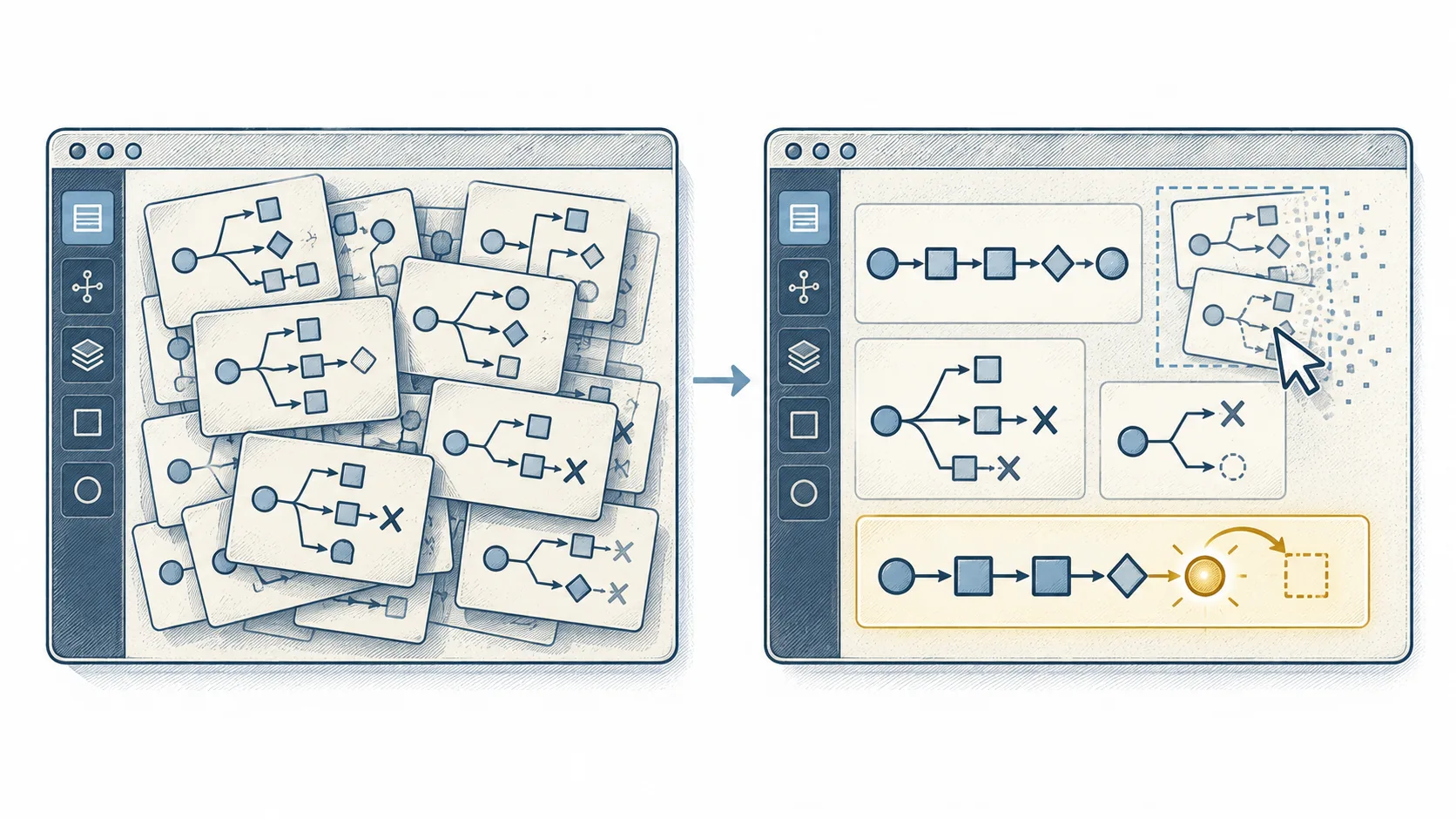
A Context Language Model treats its context as a file it can update without restrictions. It can rewrite old messages, preserve important facts, remove irrelevant information, maintain progress notes, and learn its own strategies. The researchers emphasized that language models can learn strategies that go beyond existing human-designed approaches, potentially surpassing existing human priors.
Shifting context management from external harness control to intrinsic model behavior naturally enables in-context learning and parametric learning. Users can steer context management simply by telling the agent their desired strategy. Context Language Models can also evolve an in-context skill document capturing useful procedures for future reuse.
New learnable behaviors include creating internal notes, removing irrelevant intermediate results while preserving useful ones, and tracking unsuccessful experiments alongside ideas to explore further. The researchers explored zero-shot context management, in-context learning with natural language instructions and an iterative skill-optimization loop, and reinforcement learning using task success and computational efficiency.
Benchmarks show performance gains
The researchers evaluated Context Language Models across several benchmarks and reported substantial gains in performance and computational efficiency. Zero-shot models achieved 11.4 percent higher accuracy with 21.5 percent fewer floating-point operations on BrowseComp-Plus. They also reached 5 percent higher scores with 59 percent fewer floating-point operations on 12-hour EdgeBench, and 65 percent greater improvement with the same compute on a 24-hour multi-repository agent-swarm task.
Context Language Models using in-context learning improved accuracy on ContextBench tasks by up to 35.9 percentage points at lower compute. Reinforcement learning improved Qwen3.5-9B performance on BrowseComp-Plus from 28.8 percent to 42.5 percent, marking a 47.6 percent relative improvement while using 12 percent fewer floating-point operations.
The researchers acknowledged several unresolved challenges. A Context Language Model may discard important information that it cannot later retrieve. Allowing models to edit their own context introduces new safety risks because the editable context can become another channel through which prompt injections or self-generated instructions persist across turns. Greater control over context does not necessarily translate into better behavior, as models may still make poor decisions about what to retain, modify, or discard.
 Read nextOpenAI details cases of misaligned AI models bypassing rules and corrupting environments
Community reacts to the findings
Commenting on the announcement on X.com, user Rennix7t warned that the accuracy and computational power results in the paper come from specified tasks. User omarsar0 described the approach as an interesting research direction but expressed reservations about trusting a model to manage its context end-to-end, arguing that better solutions are still needed.
On Reddit, user Combinatorilliance argued that Context Language Models are not yet production-ready. The user noted that rewriting the context invalidates the model cache and stated that the caching trick used by the researchers has drawbacks that need consideration.