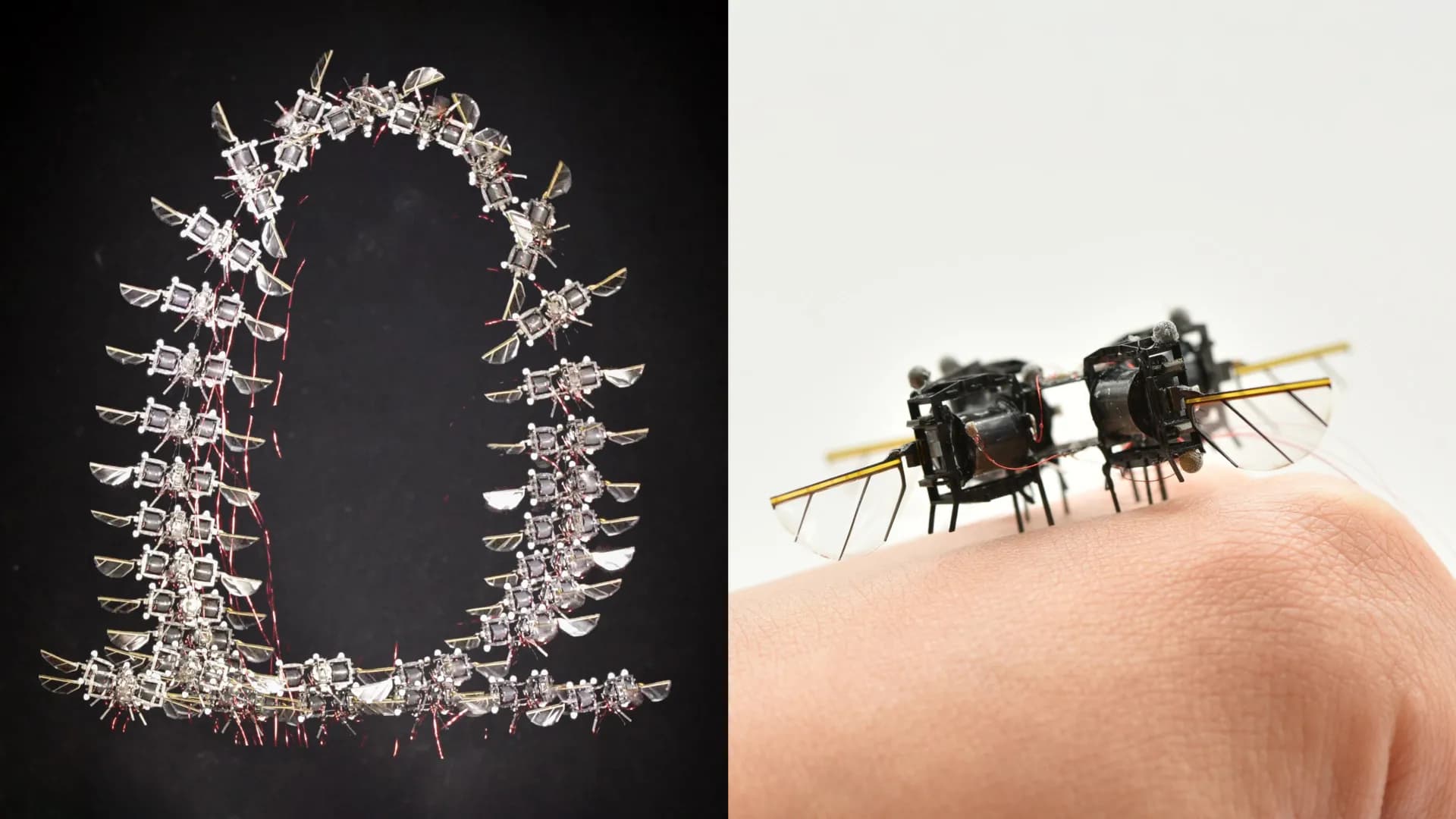

Tiny flying robots could one day help rescuers search for people trapped beneath collapsed buildings after earthquakes. These robotic insects can potentially move through narrow spaces that larger drones cannot enter while avoiding walls, debris, and falling objects.
Aerial microrobots have traditionally been far less nimble than the insects that inspired them. They typically moved slowly and followed relatively simple flight paths.
Researchers at MIT have now demonstrated a new approach that gives an insect-scale flying robot much greater speed and agility. The team developed an artificial intelligence controller that allows the robotic bug to perform demanding aerial maneuvers, including repeated body flips.
Using a two-part control system designed to balance performance with computational efficiency, the researchers increased the robot's speed by about 450 percent and its acceleration by about 250 percent compared with previous best results. The robot completed 10 consecutive somersaults in 11 seconds despite wind disturbances.
Kevin Chen, an associate professor in the Department of Electrical Engineering and Computer Science, explains that the goal is to use these robots in scenarios traditional quadcopters cannot reach. Chen serves as head of the Soft and Micro Robotics Laboratory and co-senior author of the study.
Chen's group has spent more than five years developing robotic insects. The team recently created a durable version about the size of a microcassette that weighs less than a paperclip, featuring larger flapping wings driven by soft artificial muscles.
The physical design improved, but the controller remained a major limitation. Earlier versions required manual tuning by a human.
To solve this, Chen's group collaborated with Jonathan P. How and his team to develop a two-step artificial intelligence control system. The first part uses a model-predictive controller to plan difficult movements.
The researchers then used this planner to train a deep learning policy through imitation learning. This serves as the robot's real-time decision-making system.
Experiments showed the system increased speed by 447 percent and acceleration by 255 percent. The team also demonstrated a rapid pitching movement known as a saccade.
The research was published in Science Advances and funded by the National Science Foundation, the Office of Naval Research, Air Force Office of Scientific Research, MathWorks, and the Zakhartchenko Fellowship.
Future research goals include equipping the microrobots with onboard cameras and sensors to enable outdoor flight without an external motion capture system, and investigating coordinated movement for groups of robots.