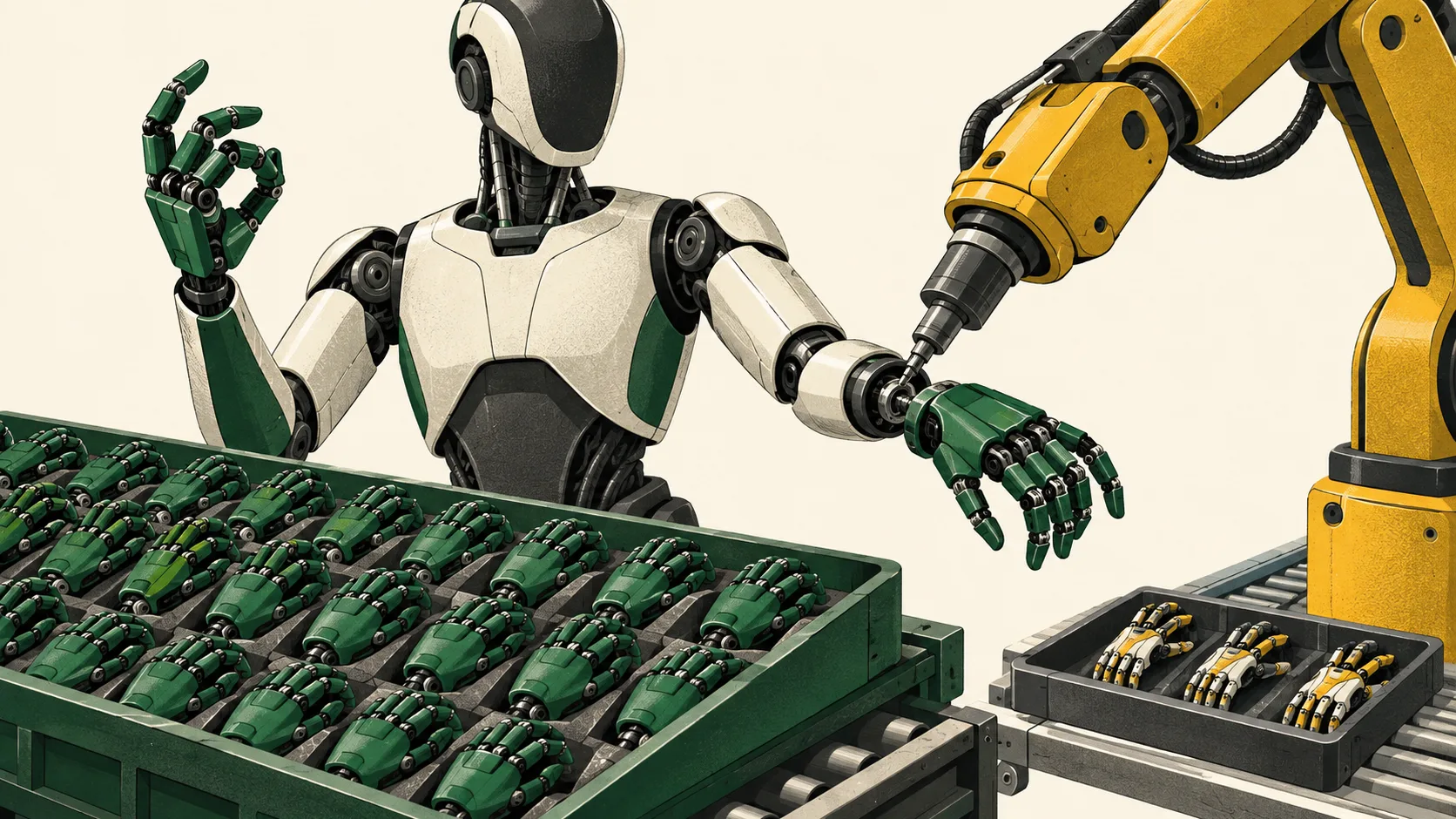

Chinese companies supplied nearly all dexterous hands for humanoid robots in the first half of 2026. Western players are starting to close in as they scale up humanoid production.
A new report from Smart Analytics Global found that Chinese firms accounted for 96 percent of shipments for hands with six or more active degrees of freedom. The Western share remains small at 4 percent, but it has roughly quadrupled since 2025. Figure AI is a key driver of this Western growth.
The report highlights a split in strategy between regions. Chinese companies sell hands as standalone components. Western producers favor customized or in-house designs.
 Read nextChina Expands Global Footprint in Health Tech and Biotech Innovation
Linda Sui from Smart Analytics Global stated that the gap reflects markets at different stages of maturity. China is moving faster to industrialize dexterous hands as a standalone component. This is supported by specialized suppliers and a broader component supply chain.
China's broader manufacturing ecosystem gives its robotics companies access to motors, reducers, sensors, and actuators. Ben Armstrong from the HAND group noted that China's advantage extends beyond humanoids due to long-term industrial automation investments. Localized supply chains allow Chinese companies to iterate and improve designs faster than North American or European peers.
George Chowdhury from ABI Research argued that the market comparison is somewhat arbitrary. Western vendors focus on commercial solutions and guard their intellectual property. Chinese companies focus on high-volume hardware sales at the lowest cost.
Chowdhury explained that Chinese vendors compete for subsidies and prioritize shipping high numbers of units. Meanwhile, the United States imposed a ban on imports of Chinese robots and robotics components in July.
Market demand is also shifting toward reliability over raw degrees of freedom. Smart Analytics Global found that adoption rates for hands with six or more active degrees of freedom fell in the first half of the year. Many early industrial tasks do not require that level of dexterity.
Sui noted that component development is becoming increasingly application-driven. Chowdhury added that the robot brain, including vision-language-action and world models, remains the crux of the market. However, force feedback and touch will become important as robots move into homes.
The next known step for the market involves observing whether in-house development and third-party supply coexist as the industry matures.