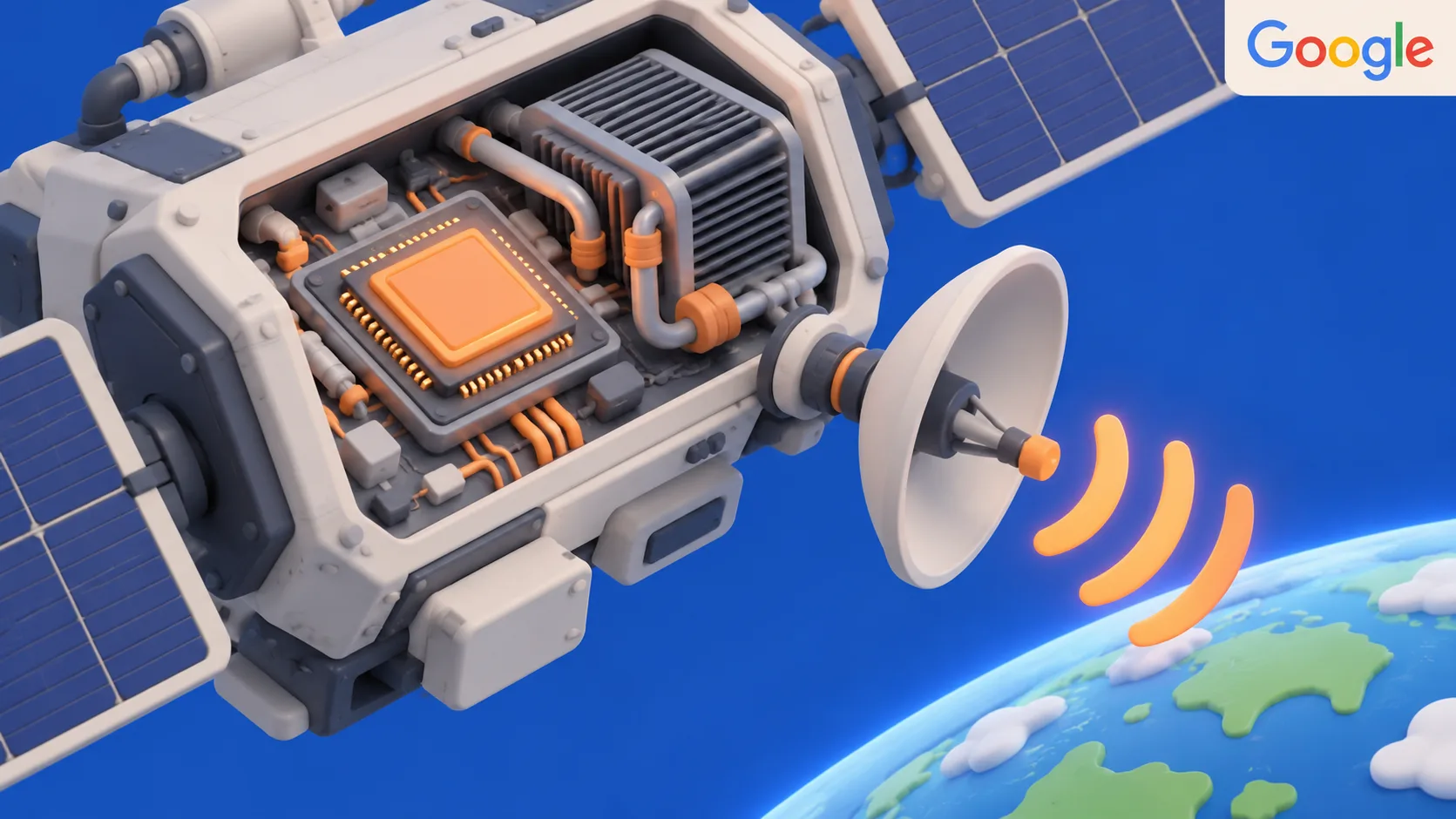
Google reports first AI response from Project Suncatcher satellite
Google says its Project Suncatcher prototype returned an AI response from a data center class TPU in orbit after its October 1 launch.
Product
EmbeddingGemma 2 is an open multimodal vector model from Google that represents text, code, images, video, and audio in a single 768-dimensional space. The model converts various media types into numerical vectors, allowing developers to compare different content formats directly for search and retrieval applications. Currently, EmbeddingGemma 2 is available in two distinct configurations. The text and code version features 270 million parameters, while the full multimodal version contains 740 million parameters. According to Google, the 740-million-parameter model outperforms competitors twice its size on multimodal benchmarks. The model runs locally on devices via WebGPU, requiring about 191 MB of RAM and no API key. This setup supports offline retrieval-augmented generation and can reduce local vector database storage requirements by up to six times. When configured to shorter 128-dimensional vectors, EmbeddingGemma 2 retains around 90 percent of its text retrieval quality and approximately 75 percent of its performance for image, video, and speech retrieval. Recent developments show its integration into consumer software, such as Google AI Edge Foresight, a local-first meeting note-taker for Mac that utilizes EmbeddingGemma 2 to function offline without an internet connection.
5 stories · Updated
Google says its Project Suncatcher prototype returned an AI response from a data center class TPU in orbit after its October 1 launch.
Google's EmbeddingGemma 2 places five media types in one embedding space for search and retrieval tasks.
Google DeepMind and GovTech Singapore developed an on-device model that warns users about suspected scams, with a phased rollout planned.
Google has released a new offline Mac app called Google AI Edge Foresight that competes with AI note-taker Granola.
Google launched EmbeddingGemma 2, an open model designed to convert various media types into numerical vectors for easier comparison.