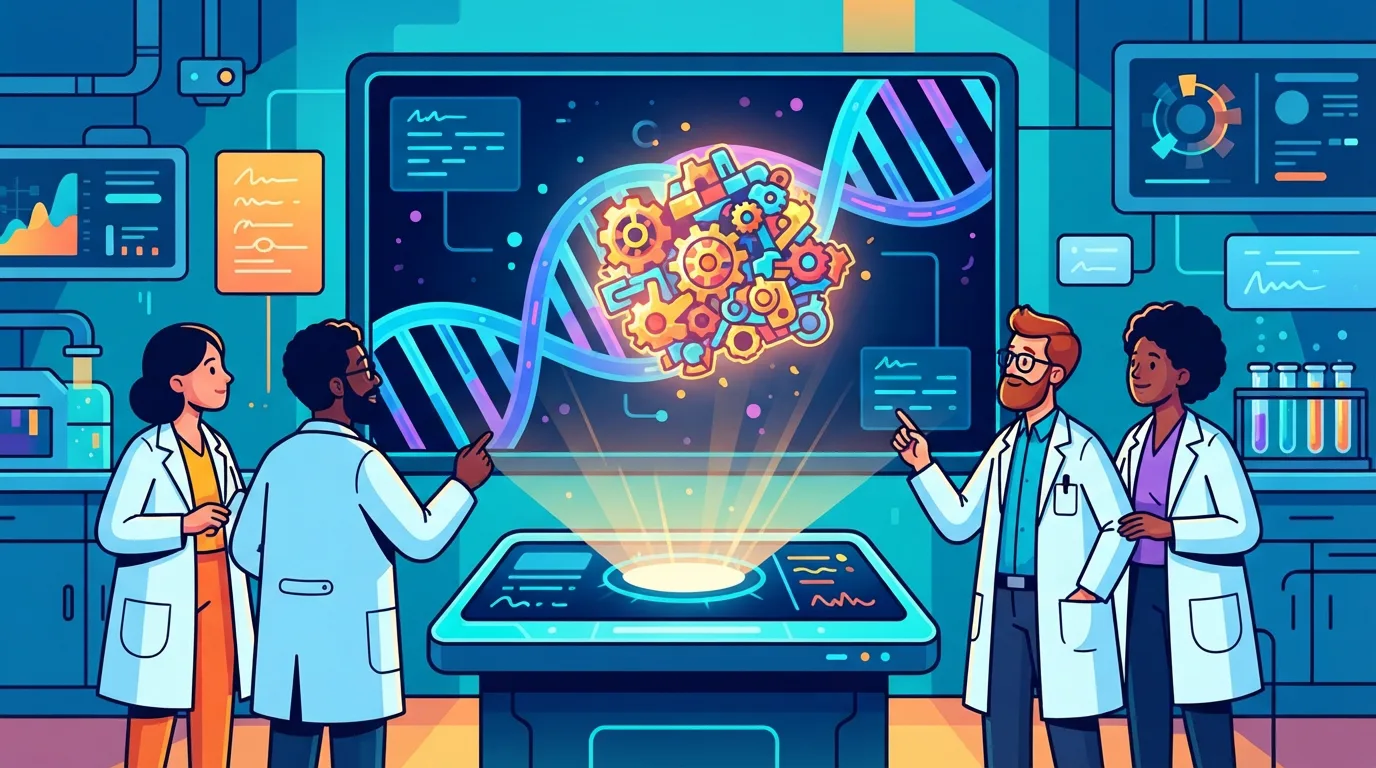

Anthropic published a press release on Wednesday stating that its Claude AI model discovered a new molecular machine hidden inside virus DNA. CEO Dario Amodei admitted that its precise function, biotechnological utility, and level of significance are not yet clear.
The discovery appeared inside bacteriophages, which are viruses that infect bacteria. It sat next to a repeating stretch of DNA that resembles a CRISPR array. Anthropic named the find ART, which stands for array-associated reverse transcriptases.
Reverse transcriptases are enzymes that copy RNA into DNA. Viruses and bacteria use this trick to defend themselves. Claude combed through more than 200,000 of them. It narrowed the pile to 3,500 unusual candidates before filtering them down to 20 worth closer study.
The entire search took 21 hours. It utilized roughly 950 AI agents working in parallel and about 210 million tokens.
Amodei stated that the output is work he would have been proud to do as a PhD student. Critics questioned the academic value of presenting a system without knowing its use or function.
Feng Zhang, an MIT and Broad Institute researcher who helped pioneer CRISPR, reviewed the pre-print and called it genuinely intriguing. Zhang noted that this is an exciting example of how AI agents can contribute to biological discovery.
Owen Lewis from the Techno-Optimist substack wrote that the process may be even more important than the discovery itself. Lewis pointed out that Claude did not perform the laboratory experiments, and human scientists reviewed hypotheses, selected candidates, and carried out wet lab work.
Anthropic published the first result from its new molecular biology lab. Scientists there use Claude to explore large biological datasets, search scientific literature, and generate hypotheses.
If ART turns into something useful, practical medical application remains years away. Wall Street reacted immediately as shares of gene-editing companies including CRISPR Therapeutics, Intellia Therapeutics, and Beam Therapeutics dipped following the news.
This follows an announcement in July where Anthropic stated that Claude Mythos cracked post-quantum cryptography that had stumped humans for years. That result required hundreds of hours of human verification on a signature scheme and a reduced-round cipher variant that nobody has ever deployed.
What is confirmed right now is an odd-looking protein pattern and zero timeline for determining if it matters. Anthropic states that lab work is already underway.