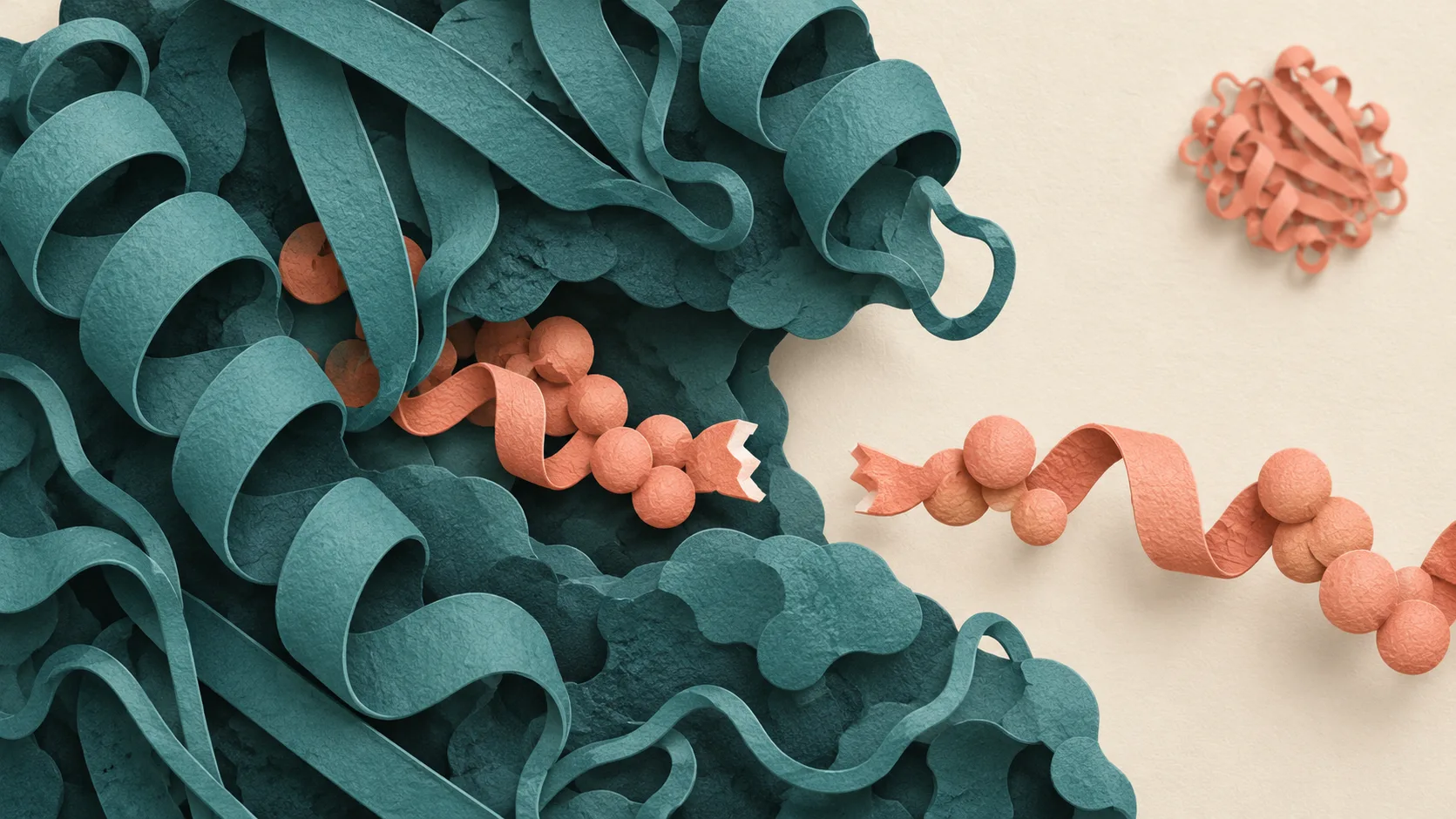

Researchers have used AI protein-design tools to build enzymes that cut selected proteins. The team, primarily from Nobel winner David Baker’s lab at the University of Washington, tested designs based on two existing proteases. It also made zinc-based enzymes that cut proteins associated with neurological disorders in cells.
Proteins are chains of amino acids joined by peptide bonds. Those bonds can remain stable in water for hundreds of years without a catalyst. Proteases speed up their breakdown. Some cut a wide range of proteins, while others recognize particular amino acid sequences.
The tools rebuilt two proteases
The researchers began with the catalytic amino acids from a zinc protease found in a crayfish digestive system and a cysteine protease from yeast. They used RFdiffusion2 to design new protein backbones that placed those amino acids near a chosen target sequence. ProteinMPNN then selected amino acids for each backbone, accounting for its intended fold, catalytic site, and target binding.
The team produced 12 backbones and 69 amino acid combinations for the cysteine protease project, and tried 135 zinc protease designs. AlphaFold3 predicted the structures of many designs. The researchers found no close matches in protein databases, indicating the tools had generated distinct structures.
In a test using a long protein joined to a fluorescent protein, 13 cysteine protease designs cut at the target site, a 19 percent success rate. All were considerably less active than the yeast enzyme used as a model.

Water placement improved the zinc designs
Of 89 zinc protease designs made without positioning a water molecule, 14 showed weak catalytic activity. Modeling suggested that water often blocked the reaction site. When the researchers included a correctly placed water molecule as a design constraint, 35 of 38 designs showed some activity. Most still worked considerably less well than the starting enzyme. One more active design lacked specificity about where it cut.
The team then changed nearby amino acids that were not directly involved in catalysis. Its best cysteine protease version sped up peptide-bond cleavage by a factor of 10^9 while remaining highly specific for its intended target sequence. A revised zinc protease was 30 times more active than its original design and accelerated cleavage by a factor of 10^10.
 Read nextXbow built Chrome exploit chain with AI assistance in six days
To test a new target, the researchers designed zinc proteases aimed at proteins associated with disorders including Alzheimer’s and frontotemporal dementia. Altering an existing design to recognize a new sequence worked poorly. Starting the design process again yielded a protease that cut its intended target in cells.
The results show that the tools can arrange catalytic components and target-binding regions, but their designs do not reliably match the activity of evolved enzymes. Before such proteases could become therapies, researchers would need to address delivery to the right cells and the possibility of immune responses.