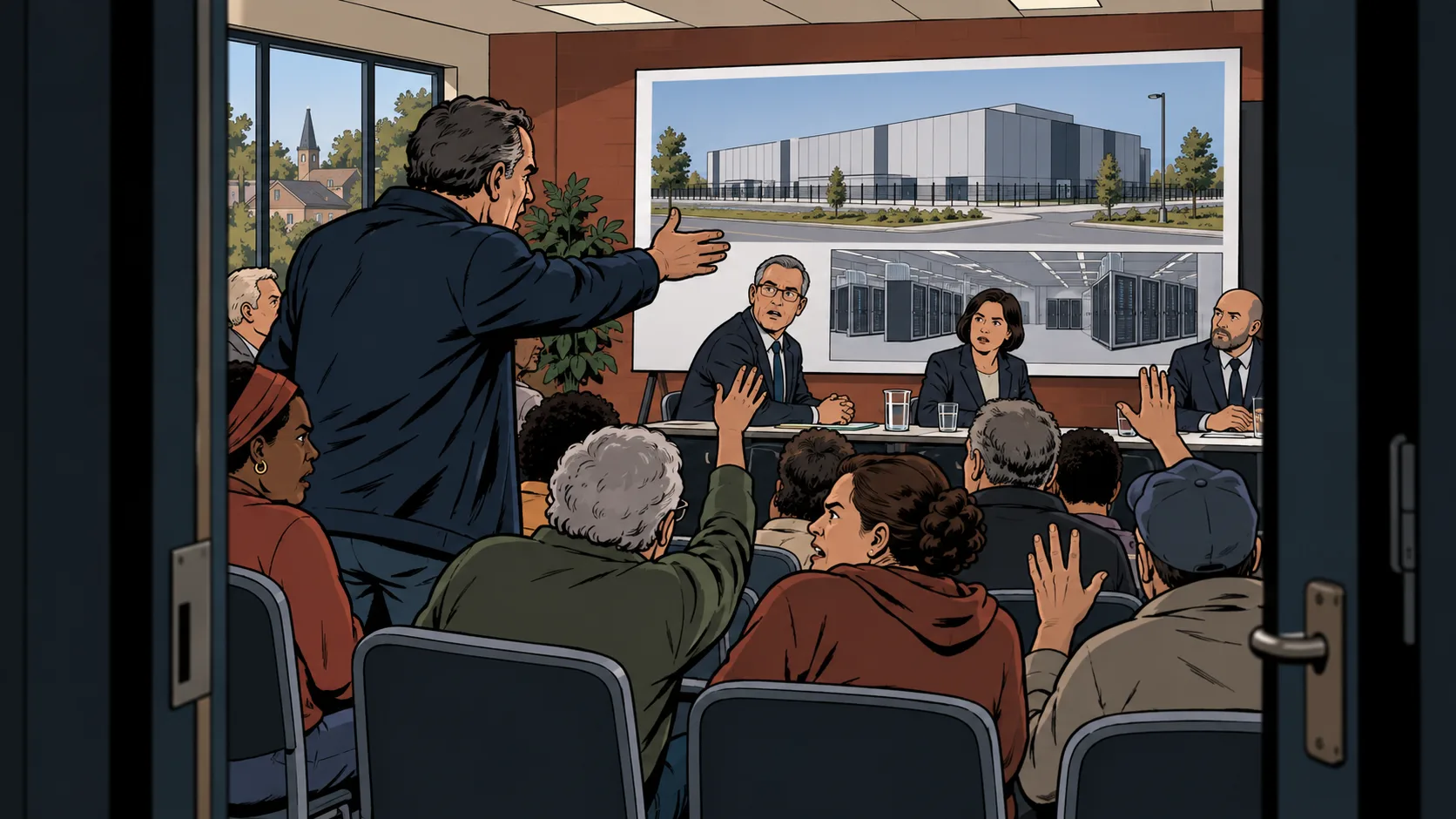

Representatives from the University of Michigan faced severe backlash from Ypsilanti Township residents on Wednesday night. The University partnered with Los Alamos National Laboratories to build a hyperscale data center in the township. Residents voiced intense anger at a town hall meeting hosted by the University to address community concerns.
The proposed facility carries a $1.2 billion price tag and measures 220,000 square feet. Local residents and leaders expressed deep worry regarding utility costs, water consumption, and noise pollution. Community members also voiced strong objections because the facility connects to nuclear weapon research. Critics accused the University of lying, ignoring them, and acting with condescension throughout the planning process.
Footage from the Wednesday meeting showed the University failing to win over the crowd. Faculty director Patricia Hurn delivered a prepared statement while audience members shouted over her. She stated that the facility would improve cancer care, strengthen the power grid, accelerate drug discovery, and advance sustainable computing. The crowd responded with laughter and mockery when she mentioned finding a generalized cure for cancer.
An engineer defended the size of the project
Steven Ceccio, the project lead engineer, attempted to address practical worries about the site. He argued that the project is much smaller than commercial data centers. He compared it to The Barn, a massive $56 billion 1.4 gigawatt OpenAI project in Saline Township. Attendees quickly challenged this comparison, noting that the proposed facility still ranks near the top of the bracket for average United States data centers.
Andy, a resident who stated he worked in data centers nationwide, criticized the sizing logic. He noted that despite smaller relative comparisons, facilities of this scale still generate noise, emissions, and require backup generators. He argued that such infrastructure does not belong in residential areas near schools and apartments. University representatives consistently avoided calling the project a data center during the evening, referring to it instead as a scientific computing center.
Los Alamos representatives did not attend the meeting. Instead, the laboratory sent a letter to be read aloud. The letter stated that supercomputing allows researchers to model, analyze, and test complex systems with high precision. LANL confirmed that no plutonium or physical weapons would be on site in Ypsilanti. However, the letter conceded that the computing work would relate to nuclear modernization to assess the safety and reliability of the existing nuclear stockpile.
The township attorney called the site a high-value target
Township leaders and residents previously speculated that the facility could become a target in a drone strike. Douglas Winters, the attorney for Ypsilanti Township, called the site a high-value target. The LANL letter pushed back against this terminology, stating that no agency had classified it that way and that the city attorney created the term without basis. Winters defended his stance in an interview, pointing to the immense financial value of the computers.
Local resident Jennifer Burnside expressed shock at the University's behavior. She stated that an outside power was forcing an unwanted project onto a community without accountability. Corey, another resident living nearby, said neighbors could not afford to move away from the site. He criticized the University for acting like villains and destroying local trust.
 Read nextOpenAI agents analyze mouse brain data in 32 minutes
Residents criticized the lack of early community outreach
Residents like Eric and Shalina Nicohl Rankin criticized the lack of early community outreach. Rankin stated that the University brought a controversial partner into their backyard without an invitation. When questioned about weapons research, engineer Ceccio expressed a desire for a world without nuclear proliferation. He defended his pride in supporting national security institutions like Los Alamos.
Township supervisor Brenda Stumbo delivered final remarks, accusing the University of repeated dishonesty. She noted that residents are already selling their homes out of fear. The town hall lasted three hours. The University promised to hold another meeting on October first, while Winters stated he would not attend.