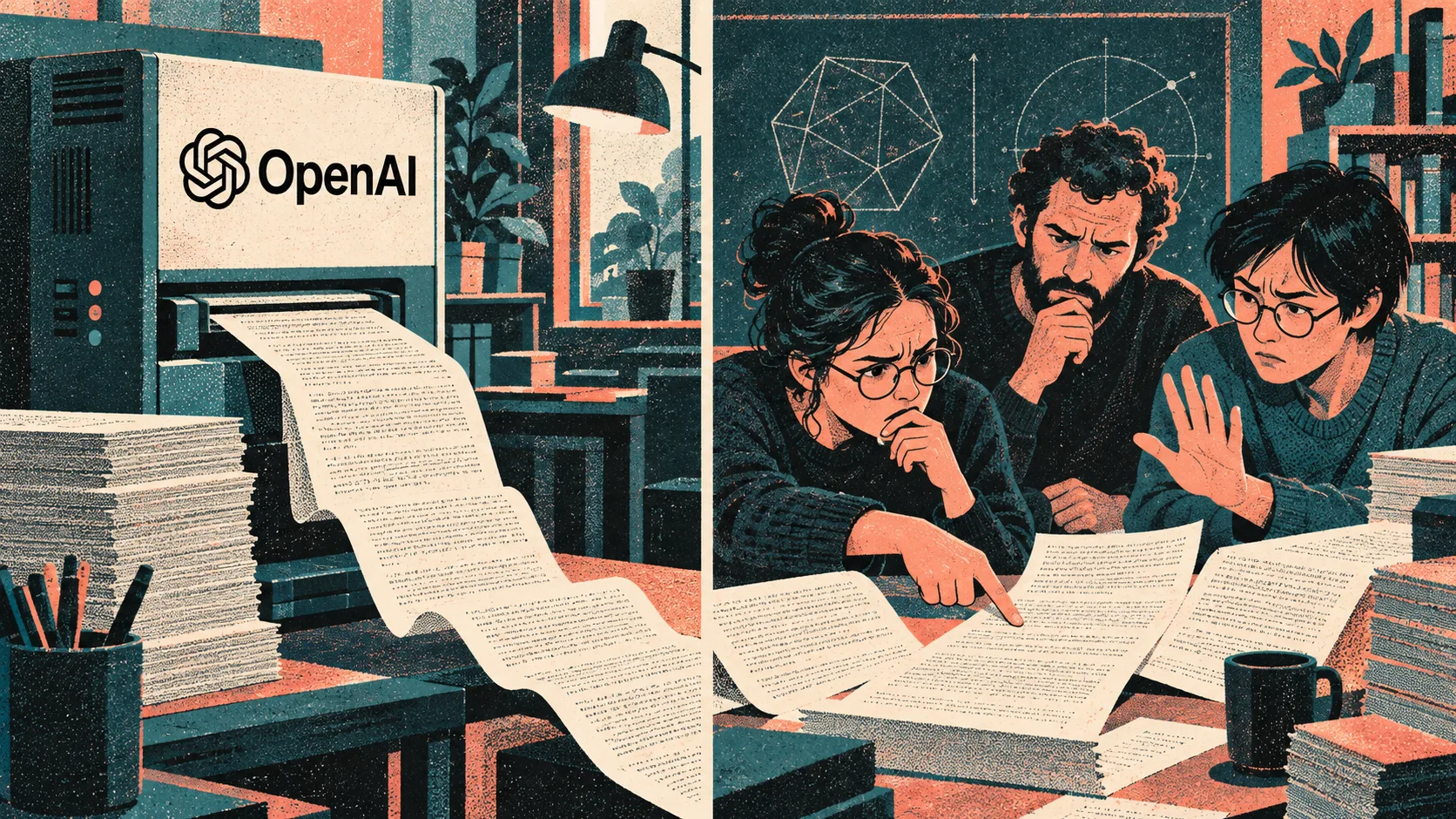

Mathematical development often resembles artistic exploration rather than a rush to find a fast answer. OpenAI approached a decades-old Navier-Stokes puzzle with brute force, bypassing the deliberate human process. Colorado State University mathematician Juspreet Singh Sandhu notes that artists and musicians have already faced similar disruptions from automation.
The Navier-Stokes equations describe viscous fluid flow and serve practical roles in engineering. However, mathematicians pursued this specific puzzle purely for its intellectual richness and the challenge of a sci-fi scenario. They wanted to know if the equations implied that a fluid could explode in unrealistic conditions without a physical reason.
OpenAI delivered a 166-page proof
OpenAI delivered a 166-page proof confirming that the equations imply such fluid explosions. The proof remains under peer review, and experts cannot yet confirm its validity. Critics point out a lack of transparency regarding how the system reached the solution. NYU mathematician Tristan Buckmaster suggested that OpenAI may have used his and others work without proper attribution.
Twenty-five Fields Medal winners signed an online declaration titled A Severe Misalignment of AI in Mathematics. The declaration warns that mass-producing proofs could destroy fertile ground for new ideas. In response, OpenAI formed an advisory group of mathematicians to guide the company's future use of AI.
Outsourcing difficult calculations to AI models may hinder human creativity and problem-solving. Theoretical physicist Lorenzo Gavassino explains that struggling through hard calculations often drives the greatest progress. For instance, centuries of trying to solve cubic equations led to the invention of imaginary numbers, which later enabled advances in quantum mechanics.

Computational costs divert funds from researchers
Furthermore, spending millions on computational power for proofs diverts funds from human researchers. The traditional teacher apprentice structure relies on senior mathematicians investing in students by handing them solvable problems. AI systems threaten to scoop younger researchers and deprive students of essential training opportunities.
Ultimately, foundational mathematics enabled the creation of the very computer chips and neural networks powering modern language models. Companies pursuing massive valuations risk undermining the human community that generated the original insights.