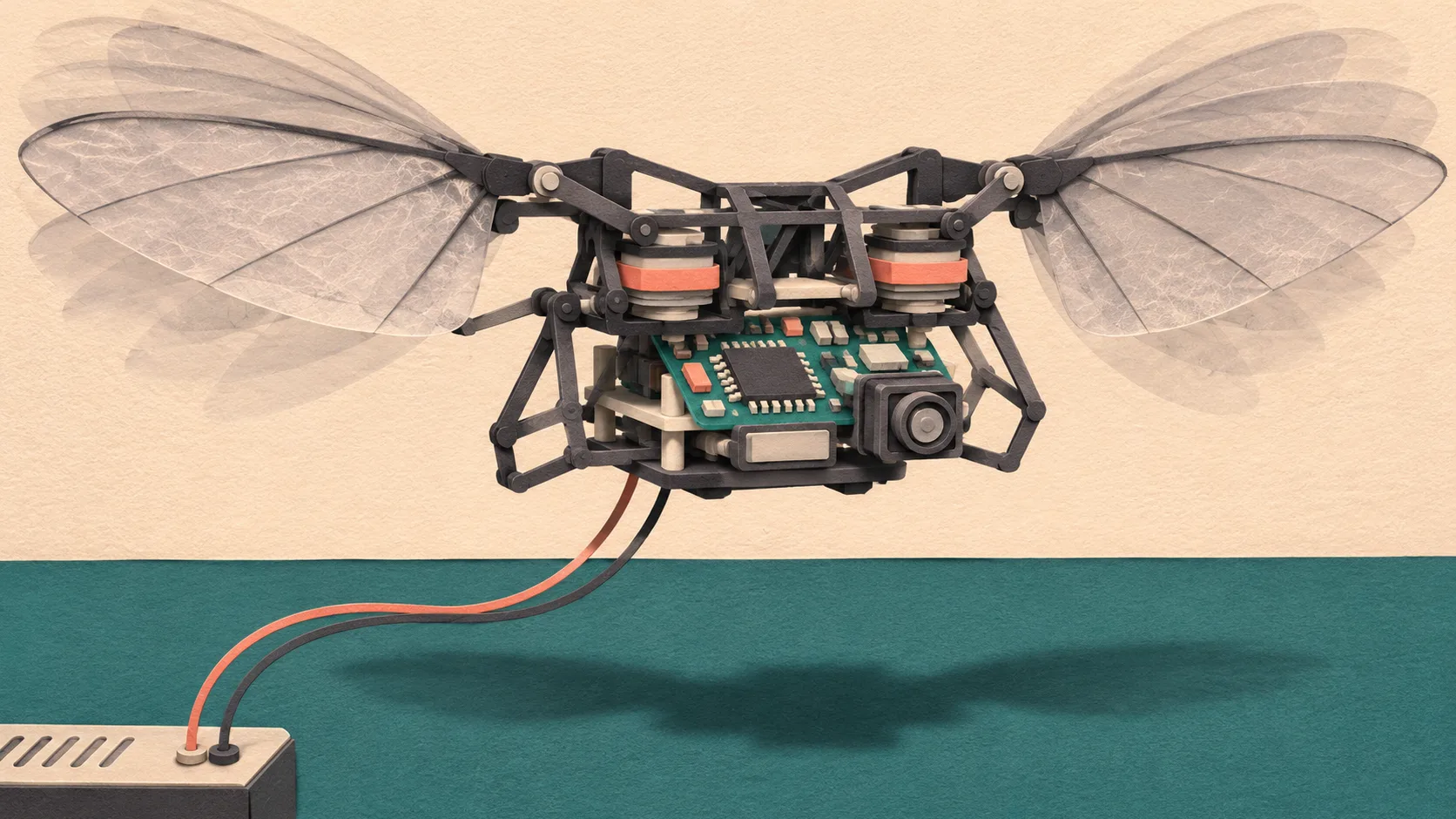

MIT researchers have built a featherweight flying robot that carries its own sensors and computer. It can follow a flight path without the motion-capture cameras used to track earlier versions. The robot still draws power from an external source.
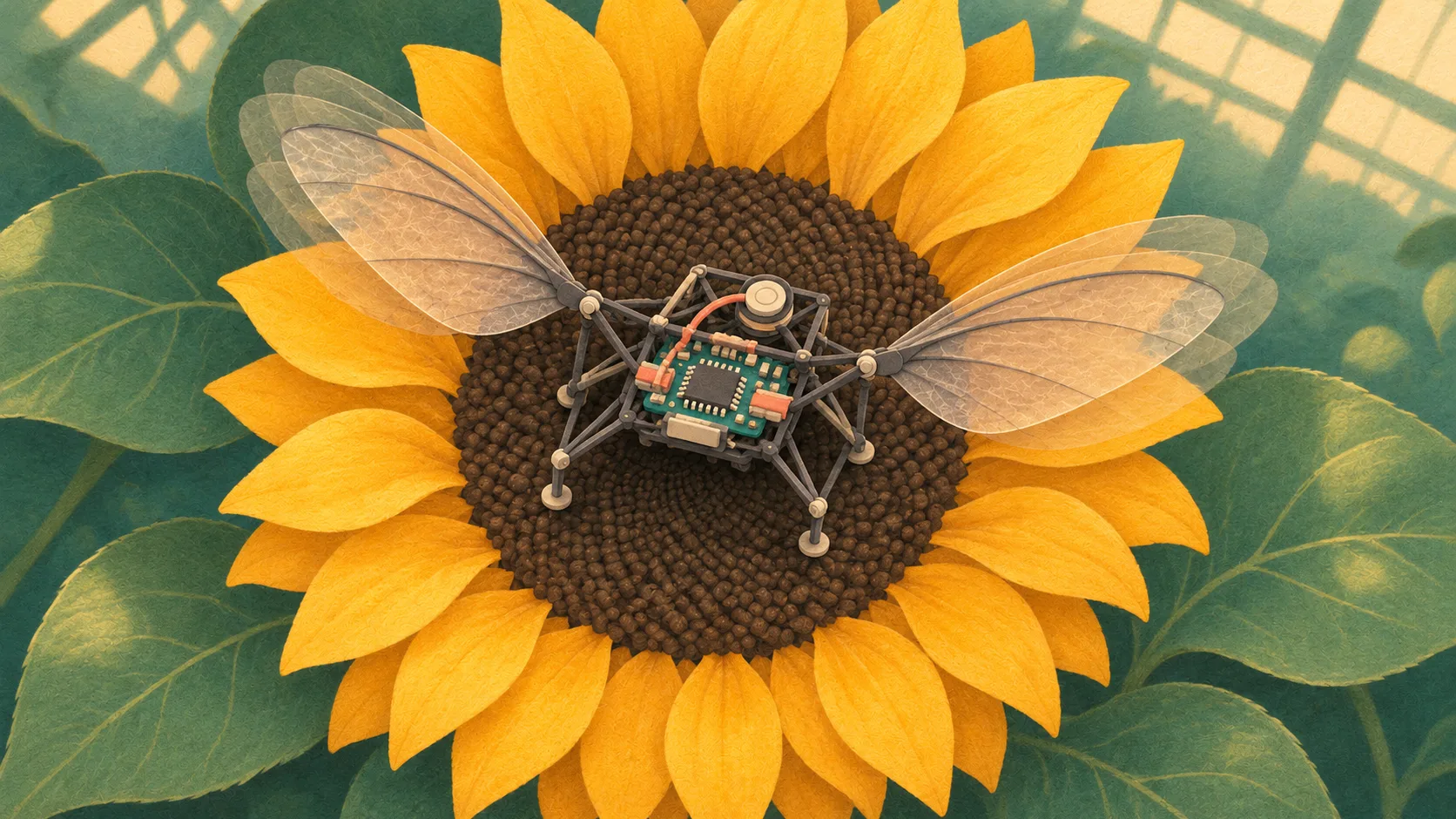
The four-winged robot is roughly the size and shape of a microcassette and weighs less than a paperclip. MIT says it demonstrated the robot flying along a complex path and landing on a sunflower outside the lab’s motion-capture environment. A researcher guided the landing by sending position targets with a joystick.
Larger artificial muscles increased net lift force
Making room for the electronics required more lift. The team increased the size of the artificial muscles that drive the wings by 50 percent and raised net lift force by 46 percent. The resulting lift-to-weight ratio was 1.9. The onboard electronics package weighs 244 milligrams.
That package includes a microcontroller and three types of sensors. An inertial sensor estimates the robot’s orientation, an optical-flow sensor helps track sideways motion and position, and a time-of-flight sensor measures height. A sensing algorithm estimates the robot’s position and movement without external cameras.
In flight tests, the robot hovered at different heights and followed routes between points, with position errors of a few centimeters, according to MIT. The team also guided it around plants before landing it on the sunflower. MIT describes this as the first demonstration of an aerial microrobot with onboard sensing and computation.
The team is working to add onboard batteries
The researchers see possible uses in crop monitoring and pollination, but those remain future applications. Their power analysis found that the electronics used about 6 percent of the robot’s total power; most went to the artificial muscles and wings. The research appears in Science Robotics.
The team is now working to add a camera for object recognition and obstacle avoidance. It is also working to put power electronics and batteries onboard, which would allow the robot to fly outdoors without a tether.