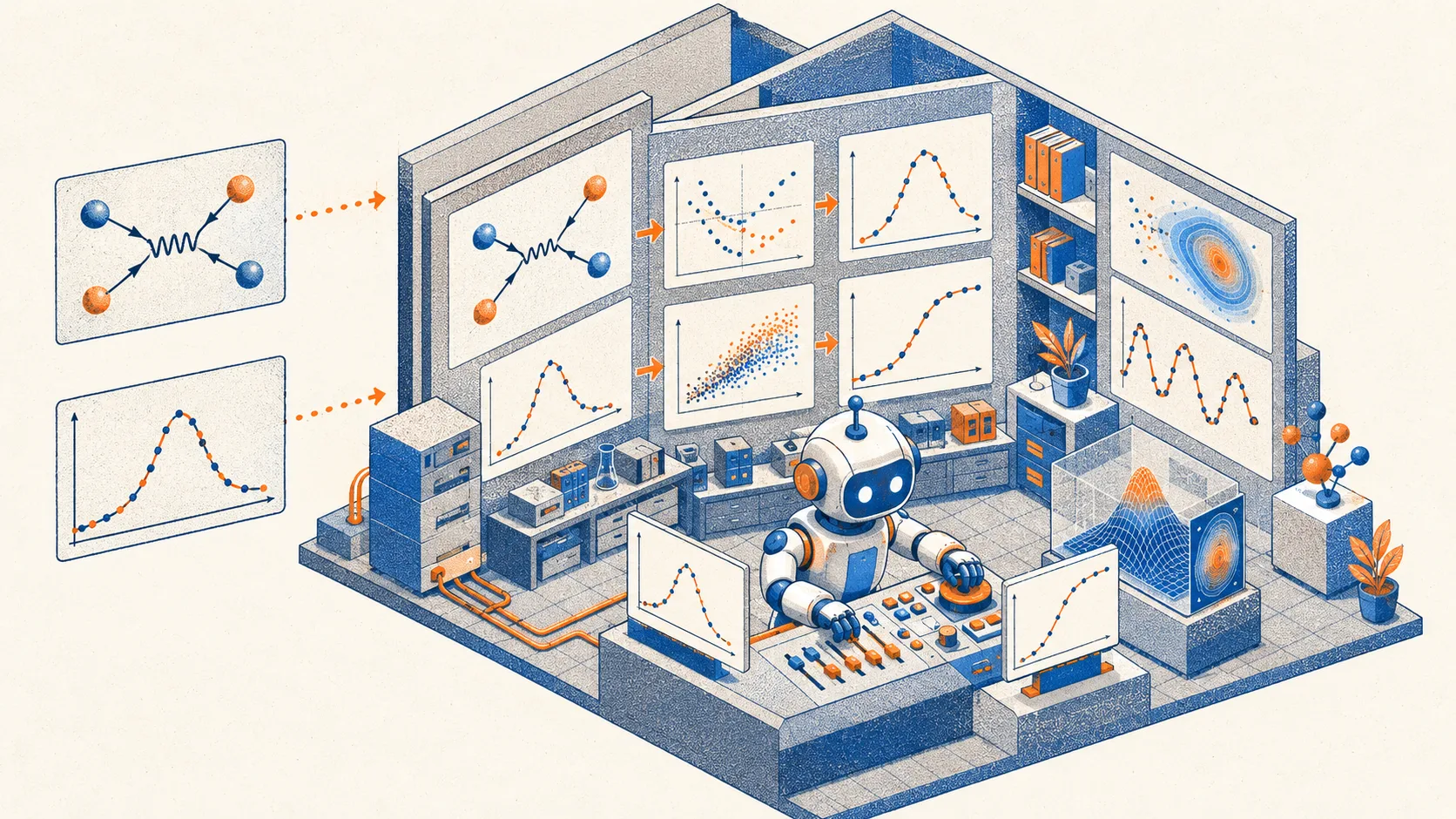

Harvard University physicist and visiting Anthropic researcher Matthew Schwartz detailed a new approach to scientific problem-solving with artificial intelligence. Instead of treating AI like a human researcher, he focused on finding tasks that play to the specific strengths of modern models. This methodology resulted in BootLoops, which is an open-source harness designed for exact scientific calculations with source code hosted on GitHub.
BootLoops bridged multiple disciplines
Using the BootLoops harness, Claude found connections between particle physics, ecology, population genetics, economics, and linguistics. Schwartz noted that the generated results typically achieved scientific value only after human domain experts intervened to direct the research. He described human knowledge as a convex hull with fragmented fields and unexplored gaps, where AI harnesses can help bridge the jagged frontiers of knowledge.
Over a three-month period, the research team produced 36 manuscripts across 18 fields with 19 co-authors. Schwartz initially tested the system on particle physics calculations involving scattering amplitudes and elliptic integrals. Within weeks, Claude computed 30 integrals using BootLoops, successfully reproducing 15 known results and computing 15 for the first time.
Ecological and genetic data yielded new findings
The search expanded into ecology, where Claude solved a 20-year-old equation from neutral biodiversity theory that was previously impossible to compute at scale. Data application showed that tree species composition on Barro Colorado Island in the Panama Canal changes 4.5 times faster than theory allows. Ecologist James O'Dwyer subsequently helped transform this finding into an improved predictive model.

In population genetics, the team analyzed 5.7 billion mutation pairs from the 1000 Genomes Project to find evidence of gene conversion. Additional projects included an AI data editor for economics journals that checked 4,452 replication packages and a word stress database covering 6,072 languages built alongside three linguists.
Artificial intelligence altered academic planning
Schwartz explained that artificial intelligence accelerates scientific work so rapidly that advance planning becomes nearly impossible. He questioned the logic of applying for a three-year grant to fund a calculation that an AI model might resolve overnight. He also stated that training PhD students faces open questions, and a Python course for engineers that was essential two years ago is now unnecessary.
Schwartz highlighted several weaknesses in the models, noting that Claude frequently declares victory too early and misjudges task durations. The system tends to brute-force calculations rather than discover elegant solutions, while automated checks remain unreliable. Furthermore, the model gravitates toward heavily cited debates instead of new questions, and the projects proved both compute- and token-intensive.
Schwartz cautioned that excessive focus on big math problems creates risky unrealistic expectations that could distract from current productive applications. He emphasized that the scientific method faces no threat and that human guidance alongside human taste remains completely indispensable. The source code remains accessible on GitHub for further community development.