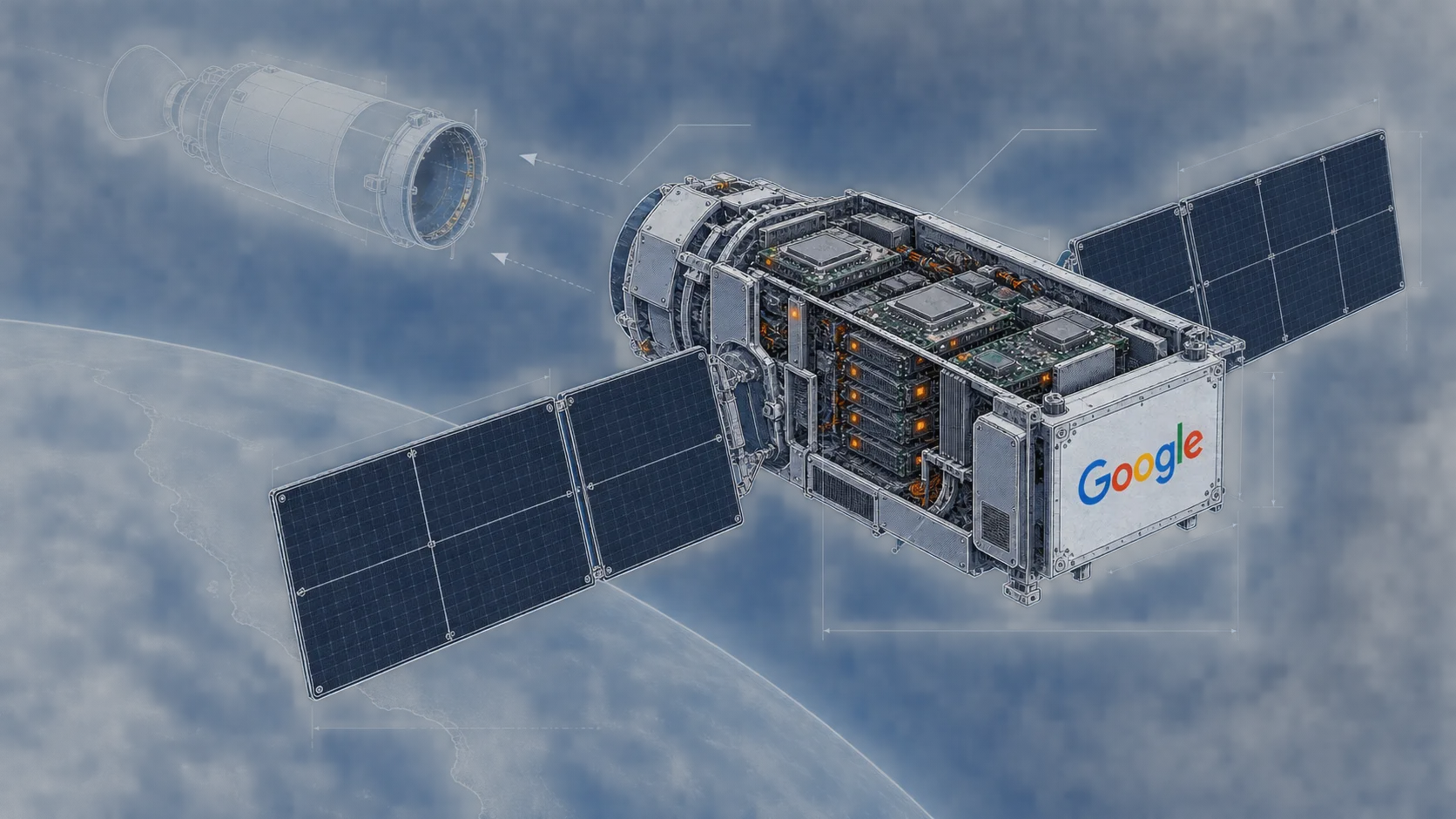

Google just launched an orbital compute satellite into space. A SpaceX rocket carried the device aloft from California. This flight marks the first time the tech giant has sent an advanced chip into orbit.
Planet Labs built the satellite
Planet Labs built the satellite to prove a Google Tensor Processing Unit can function in space. The chip competes with Nvidia graphics processing units. The test requires supplying a kilowatt of continuous power, cooling the hardware, and running models to detect any faults.
Travis Beals manages Project Suncatcher for Google. He notes that ground testing cannot fully replicate the real environment. The satellite will fire up its TPU in 15-minute bursts to protect thermal and power systems.
Google plans future orbital data centers
Google and Planet Labs are planning a follow-up flight next year featuring two satellites built specifically for advanced compute workloads. Those future units will attempt to collaborate via a laser communications link. The long-term moonshot aims to build an orbital network of 81 satellites flying in formation for parallel processing.
Google also published a peer-reviewed white paper on orbital data centers in Joule. The authors analyze how rocket launch prices might drop over time. They assume SpaceX maintains a price-reducing learning curve of roughly 20 percent per year since the Falcon 1.
Starship needs many more flights
The research suggests SpaceX could reach launch prices near $200 per kilogram by 2035. Achieving that cost trajectory requires Starship to fly 370,000 tons of payload into orbit. That volume requires about 1,800 launches over the next decade if each flight carries 200 metric tons.
Google remains confident that its chips can survive space radiation for a five-year satellite lifespan. Particle accelerator tests showed low error rates for typical inference operations. However, the error rate remains problematic for mega-scale training runs spanning thousands of chips over many months.