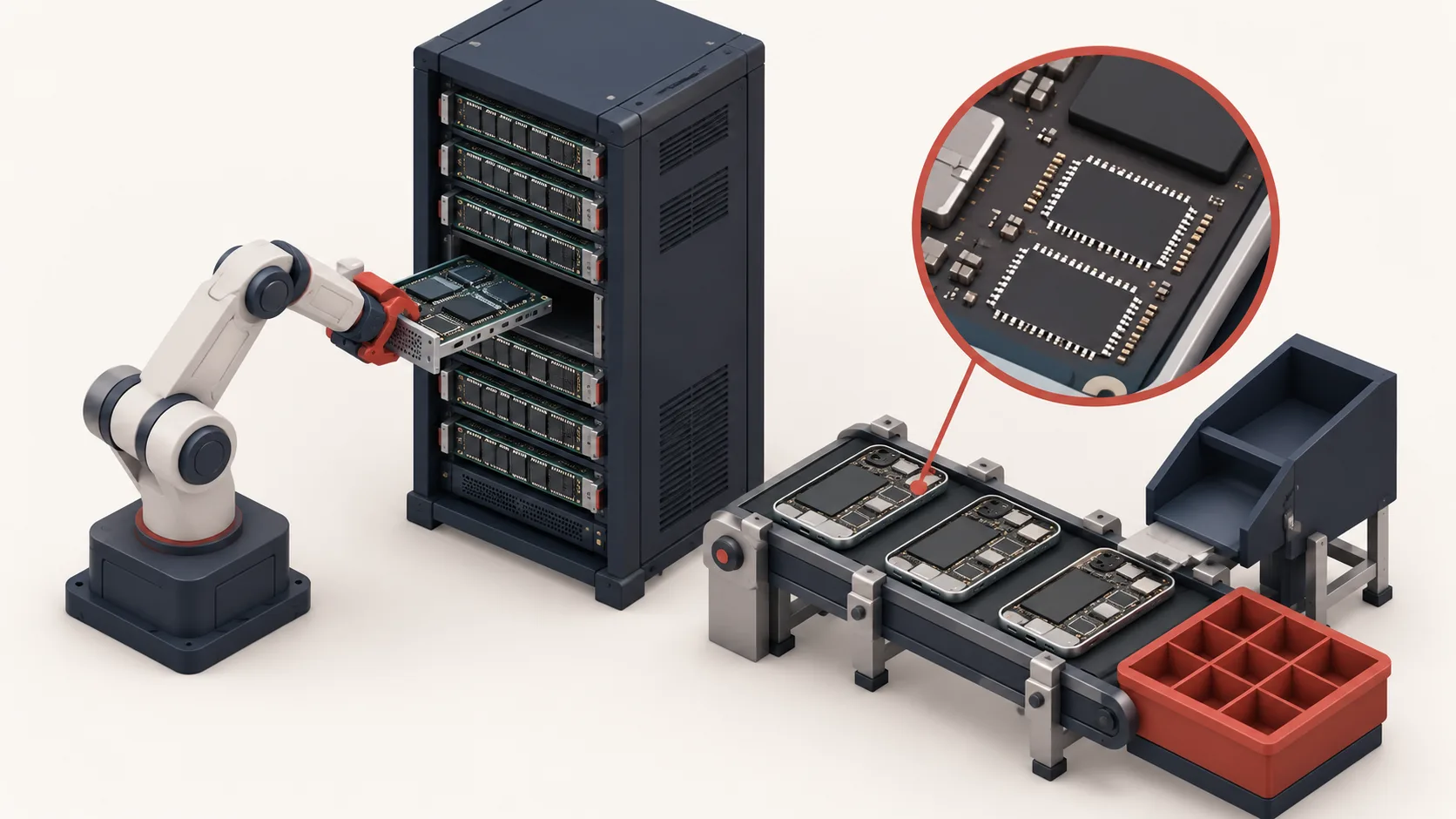

The world's cheapest smartphones are disappearing because artificial intelligence infrastructure is absorbing vital components. Prices of existing smartphone models have risen by about 15% globally this year. Newly launched models are roughly 25% more expensive than last year.
A global memory chip shortage, driven by demand from AI data centers, is pushing up the cost of making smartphones. Chinese smartphone makers account for approximately 60% of all smartphones shipped globally. These companies have drastically reduced their entry-level projects this year as memory-chip costs have risen, according to Ivan Lam, senior analyst at research firm Counterpoint. They are instead prioritizing more profitable premium devices.
Memory makers pivoted supply to AI data centers
The smartphone price increases vary sharply by region. Prices have risen by 21% in India, 19% across Asia-Pacific, and 18% in the Middle East and Africa. In the U.S., they have gone up by just 5%.
There are three primary manufacturers of memory, and in late 2025, all of them pivoted the vast majority of their supply towards AI centers instead of consumer electronics, Ramon Llamas, research director in mobile devices at IDC, told Rest of World. Samsung Electronics, SK Hynix, and Micron Technology make up more than 90% of the global memory chip market. These companies have entered several partnerships with U.S. AI giants in recent years.
S&P Global has estimated that the capital expenditure of U.S. hyperscalers will exceed $1.3 trillion in 2027. This is up from a projected $870 billion in 2026 and $470 billion in 2025.

Sub-one-hundred dollar shipments plunge globally
In 2025, more than one in four smartphones shipped globally cost less than $150. That market is now shrinking rapidly.
Chinese phonemakers including Xiaomi, Oppo, Vivo, and Huawei have built businesses around offering affordable phones. However, the economics of that strategy are changing. What used to be below $150 may become below $250, or even $300, Lam said. Companies would rather reduce investment in products below $150 or $200 and put resources into higher-margin phones, branding, user experience, and AI.
In India, Xiaomi raised the price of a 128GB Redmi 15C by 36%. In Southeast Asia, Oppo's sub-$100 phone shipments plunged 96%, and Vivo moved its main entry-level model above $100 in most markets, according to Omdia. In Africa, where 81% of smartphones shipped last year cost less than $200, shipments of sub-$100 phones fell 34% year over year in the second quarter of 2026. Shipments of sub-$100 smartphones fell almost 60% year over year globally in the second quarter of 2026.
 Read nextNvidia launches $4,999 DGX Spark with 64GB RAM amid memory crunch
Rising device costs threaten global digital inclusion
The shift could affect more than consumers looking for cheaper phones. For people who have yet to buy their first smartphone, higher prices could make it harder to get online at all, potentially widening the digital divide. The consequences will also reach the U.S. as more essential services move online and the global supply chain for smartphones becomes more expensive.
GSMA had earlier said nearly 800 million more people will use mobile internet by 2030. Claire Sibthorpe, head of digital inclusion at the group's nonprofit foundation, told Rest of World that the organization is concerned rising smartphone costs would affect this projection and widen the gap of digital inequality.
An entry-level device costs the poorest 20% the equivalent of 44% of their monthly income, and 76% for people in sub-Saharan Africa. When smartphones remain available but become unaffordable, consumers make difficult sacrifices to keep themselves online, such as delaying upgrades or going offline entirely.
The memory-chip shortage is unlikely to ease soon, according to IDC.