

Vinci4D Inc. announced on October 6, 2026, that it has closed a $250 million funding round at a $1.5 billion valuation. Advent, Temasek, and Xora jointly led the Series B deal. Several startup funds participated in the round, including AMD Ventures.
Hardware engineers rely on simulations to spot flaws in product designs. A car designer might simulate fog to test how adverse weather affects a vehicle sensor. Setting up these simulations traditionally demands specialized skills and substantial time. Consequently, many hardware teams use the technology only intermittently.
Vinci automates the engineering simulation workflow
Palo Alto, California-based Vinci aims to alter that workflow. Its namesake software platform can execute simulations after every major product blueprint change. Running a simulation the day after a design change helps engineers catch issues faster and shortens product development times.
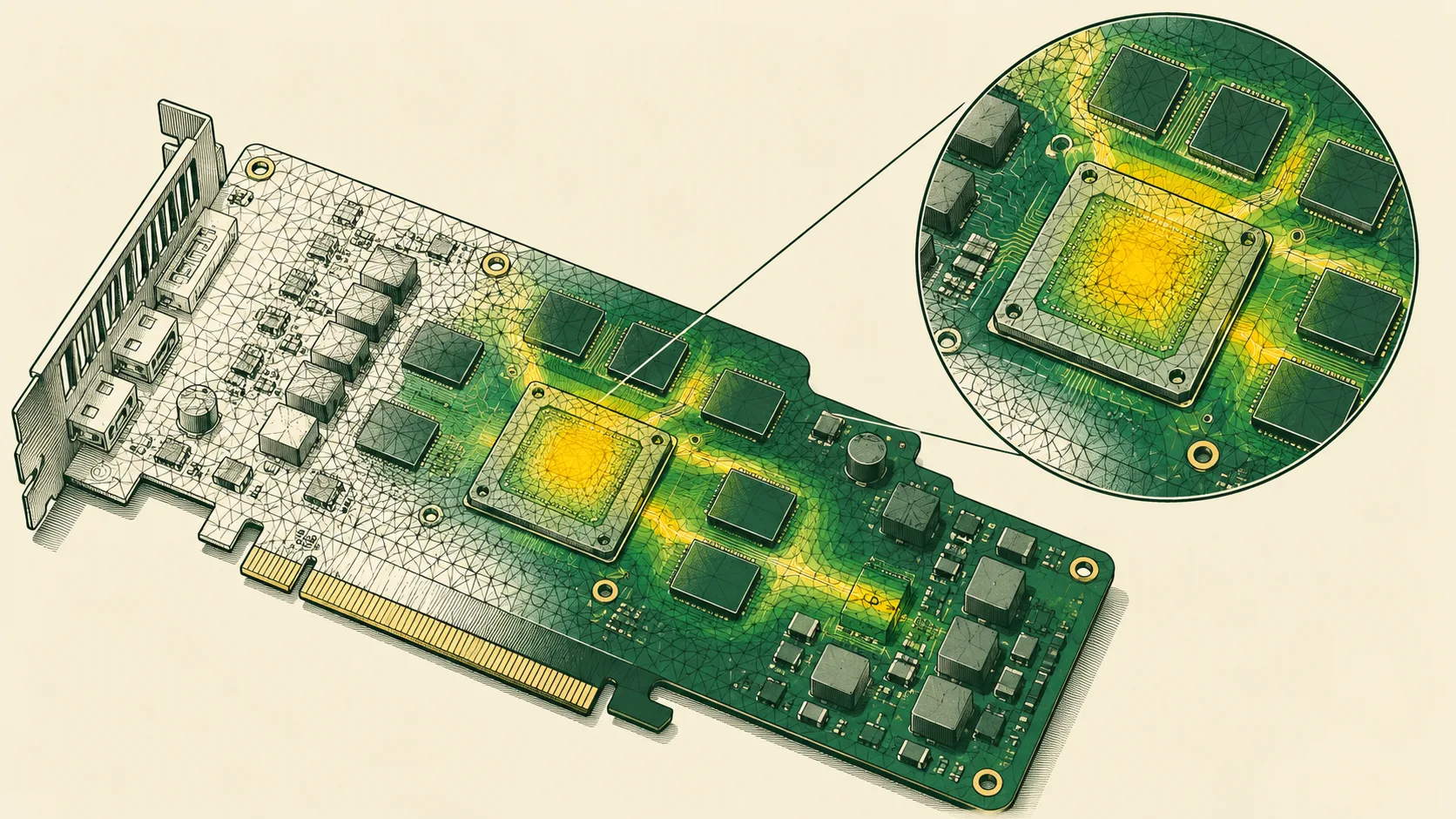
The company initially focuses on accelerating chip projects. The platform assists engineers in simulating thermal properties for processors, memory modules, and interconnects. A chip team can check whether a graphics card might overheat when running near peak frequency.
Artificial intelligence powers rapid physical simulations
A physics-focused artificial intelligence model powers Vinci. Developers upload a computer-aided design drawing of a chip, enter related data, and let the artificial intelligence build a simulation automatically.
Meshing represents one of the most time-consuming tasks in simulation projects. This process divides a product blueprint into numerous small, three-dimensional shapes. Processing an array of small shapes happens much faster than processing a continuous surface like a chip.
 Read nextAt 19, Founder Raises $11 Million for Ghost and Its Personal AI Computer
Vinci delivers rapid results for complex workloads
Vinci handles meshing automatically. The platform then uses custom graphics card kernels to accelerate convergence, which finalizes simulation calculations. Kernels act as the low-level software modules that comprise an artificial intelligence model.
Engineers measure simulation complexity through degrees of freedom, or DOFs, which describe narrow physical observations like how well a single transistor conducts heat. Vinci states that its platform finishes simulations containing hundreds of millions of degrees of freedom in a few minutes. Such workloads typically require several hours or days to run.
Vinci co-founder and Chief Executive Hardik Kabaria stated that the company starts by letting engineers understand physical behavior during the design phase. He added that the team builds toward systems that identify necessary changes, combine complex engineering domains, and help engineers create new things.
Vinci plans to expand its platform capabilities beyond chips to encompass vehicles, aircraft, and satellites.