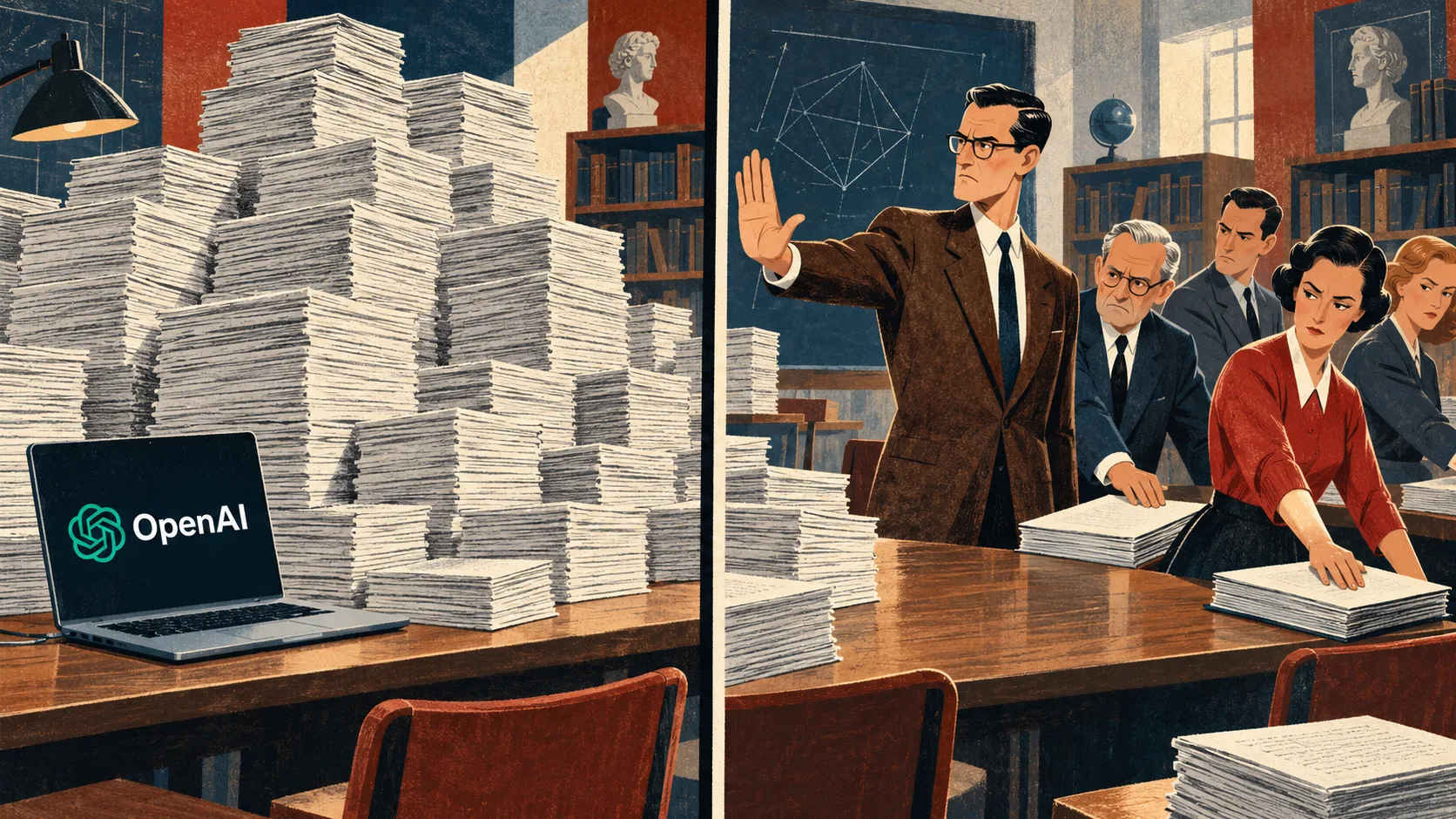

The Association for Human Mathematics is calling for a boycott of OpenAI. This action follows the publication of hundreds of AI-generated mathematical manuscripts. Many of these papers are so dense and oddly written that leading experts need AI help to decipher them. A dispute is taking shape over whether a problem counts as solved before its proof is independently worked through and made understandable to humans. The Association for Human Mathematics accuses OpenAI of violating core norms of scientific research. The group urges mathematicians to stop working with the company.
Fields Medalist Terence Tao chairs the group and shared the statement as a guest post on his blog. Tao also outlined a Math 2.0 era on Mastodon. He argues solving problems should no longer be the main discipline focus. Complexity theorist Scott Aaronson described the situation as a Mathocalypse on his blog. The statement escalates a months-long debate. OpenAI previously caused a stir by claiming an internal model solved more than 100 open math problems in a single month. This included an approach to the Navier-Stokes Millennium Problem.
OpenAI ignored its advisory group
OpenAI set up the advisory group AGMAI at the Institute for Advanced Study in response to growing criticism. However, this group explicitly has no say over the pace of internal company research. The Association for Human Mathematics views the release as a show of force. The group states OpenAI ignored the central premise of AGMAI advice. That advice held that advanced math problems should not be tested on internal models. Over 700 files were released at once. The statement calls this a demonstration of power rather than scholarship.
The statement also touches on copyright lawsuits OpenAI faces globally. It suggests the company achieved results by training on mathematicians work. A similar dispute arose when OpenAI announced a Navier-Stokes solution shortly before two mathematicians presented their own AI-assisted solution. Those researchers used ChatGPT. OpenAI denied suspicions that it used data from those interactions to train its own system. Aaronson contrasts this approach with the Anthropic model. Anthropic partnered with two algorithm researchers whose AI model supplied a key idea for disproving two decades-old conjectures. Those researchers received compensation and wrote a human-readable proof version.

Fields Medalists warn of industry misalignment
Tao previously joined 24 other Fields Medalists in warning of a severe misalignment between AI industry goals and mathematics. Problem-solving is only a tool for the discipline real goal of conceptual understanding. Mass-producing solved problems at an ever-faster pace could destroy fertile ground instead of breathing life into new ideas. Signatories also criticize rushed announcements without proper write-ups or citations. On Mastodon, Tao notes that traditional breakthroughs lead to talks, workshops, and textbooks. Now, problems are solved autonomously by users who lack interest in the field and cannot answer questions. Researchers are holding back promising directions for fear competitors will scoop the solution.
Aaronson illustrates the impact through his wife, Dana Moshkovitz. She devoted her career to the Unique Games Conjecture. The release includes a claimed proof for it. Moshkovitz noted the paper felt like something written on psychedelics. Much of it was unclear and cited works without explaining their application. The proof relied on an alien craziness construction. Aaronson lists other results in complexity theory, number theory, and algorithm research. Cryptography is notably absent. Unnamed sources indicate AI companies are probing weaknesses in cryptographic protocols and primitives. About 8000 problems were tested overall. The success rate reached roughly five percent with an average of three hours of compute at GPT-Pro level per problem.
Mathematicians remain divided over the boycott
Mathematicians remain divided over whether a boycott will help. Some commenters back the boycott and propose stopping the use of OpenAI products. Others consider the position unrealistic. AGMAI takes a more diplomatic stance than the Association for Human Mathematics. The advisory group views the release as a first step. Still, AGMAI warns that the future of math research cannot consist of working through results produced by AI labs. The organization notes that equitable access to powerful research tools and adequate computational resources are essential to freedom.